Regions
Yeongdeok
영덕
A county on the East Sea known for snow crab, daege, named for its bamboo-straight legs, served along Ganggu port's crab street, and claimed just as proudly by neighboring Uljin.
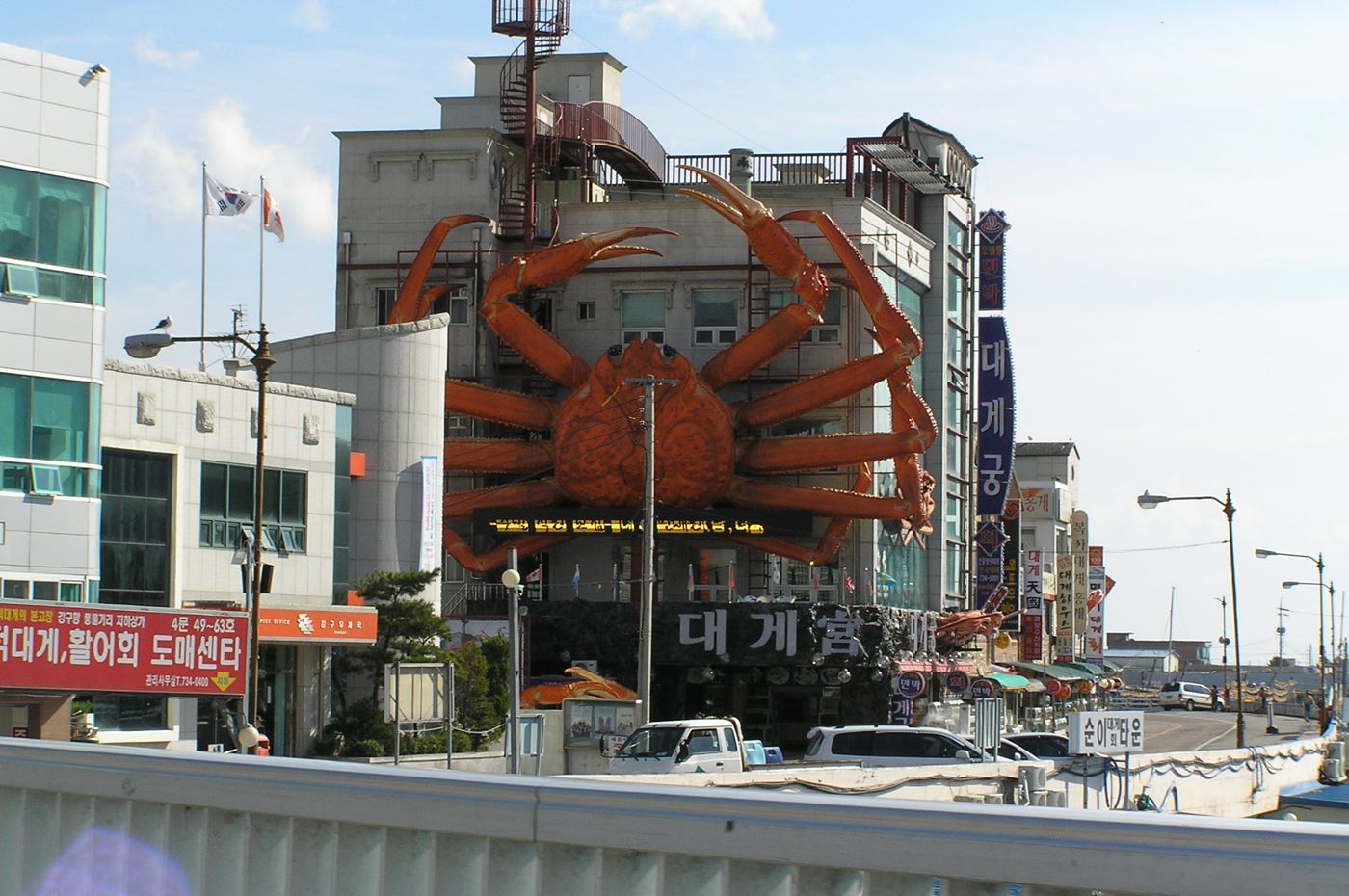
Yeongdeok is a county on the coast of North Gyeongsang, north of Pohang. Its name has become almost inseparable from one food: daege, the snow crab. The Digital Yeongdeok Culture Encyclopedia calls Yeongdeok daege the county's pride, and every winter the coast road from Ganggu to Chuksan fills with visitors who come to eat it. For the wider region, see Gyeongsang.
What daege means
Daege does not mean "big crab." Both the Encyclopedia of Korean Culture and the local encyclopedia explain that the name comes from the legs, which run long and straight from the body like bamboo (dae). The Chinese-character name is jukhae (竹蟹), "bamboo crab." The shell is close to orange on top and white underneath, and turns red when cooked. Females, much smaller than males, are nicknamed ppang-ge, "bun crab," for their round shape.
History and legend
The earliest written evidence is a list. The 1530 Sinjeung Dongguk yeoji seungnam, a national gazetteer, names eleven districts in Gyeongsang, Gangwon and Hamgyeong that produced jahae (紫蟹), "purple crab," among them Yeongdeok and neighboring Yeonghae. The local encyclopedia reads jahae as covering both red snow crab and today's daege; that is an interpretation, not a certainty.
Beyond that, the stories are legends. One says Wang Geon, founder of Goryeo, was served crab here in 940. Another says that in 1346 an official touring the area crossed a hill by ox cart to an unnamed village and was treated to crab, and the village was named Chayu, "where the cart crossed," in memory. A third tells of a Joseon king who longed for crab and sent an official, who found a fisherman's catch at Jukdo, "bamboo island," and named it for its bamboo-like legs. Chayu village, in Chuksan-myeon, was designated by the county in 1999 as the "original village" of Yeongdeok daege.
From canned crab to crab street
The modern fame is better documented. The local encyclopedia records that canneries at Ganggu and Chuksan began processing crab in 1937, and that daege became famous nationwide in the 1950s, when a Ganggu seafood processor sold canned crab across the country. Demand grew, overfishing followed and catches fell. In 1969 the county put a crab on the cover of its statistical yearbook, and from then on daege became its emblem. Yeongdeok registered the "Yeongdeok Daege" trademark in 1998, the year its crab festival began, and the Ganggu area was designated a special crab zone in 2005. That is branding, but it rests on a real fishery.
The fishery and the season
Snow crab live in cold, deep water. The local encyclopedia describes sandy or muddy bottoms at about 200 to 400 meters and a strong preference for temperatures below 3°C, and says the crab caught off Ganggu and Chuksan in March and April are prized because the seabed there is clean sand. The fishing season runs from December to May. To protect the stock, the Fisheries Act closes crab fishing each year from June 1 to October 31, and undersized crabs may not be landed.
Ganggu port
Ganggu, where the Osipcheon River meets the sea, is a natural harbor whose first breakwater was built in 1913–14; the name means "river mouth." It is now the county's only trading port and the center of the crab trade. The local encyclopedia counts about 170 crab restaurants along a street of nearly a kilometer, and a three-kilometer stretch around the harbor promoted as Yeongdeok Daege-ro. In 2015 the crab street was named a "Star of Korean Tourism," and the port drew about 3.2 million visitors in 2020. For cooking crab whole, see steaming (jjim).
Uljin's competing claim
Uljin County, just to the north, says the crab is really its own. The Digital Uljin Culture Encyclopedia notes that the same 1530 gazetteer lists jahae under Pyeonghae and Uljin, and argues that crab from Uljin waters came to be called Yeongdeok crab in the 1930s because, with poor roads, catches were sent through Yeongdeok, the better-connected collection point for Seoul, Daegu, Pohang and Andong. Uljin prizes crab from Wangdolcho, an offshore reef, names Geoil village in Pyeonghae as its own original crab village, and in 2003 erected a monument there asserting the crab's Uljin origins. It also tags its crabs' legs to set them apart. Both counties have festivals and both claims are part of the story; diners on this coast simply eat well either way.
Crab is a shellfish allergen; see allergens in Korean food.
Sources
- 01영덕대게 (Yeongdeok daege) — Encyclopedia of Korean Culture
- 02영덕대게 (Yeongdeok daege) — Digital Yeongdeok Culture Encyclopedia
- 03천 년을 이어오는 지역 특산물, 영덕대게 — Digital Yeongdeok Culture Encyclopedia
- 04강구항 (Ganggu port) — Digital Yeongdeok Culture Encyclopedia
- 05울진대게 (Uljin daege) — Digital Uljin Culture Encyclopedia
- 06울진대게유래비 (Uljin daege origin monument) — Digital Uljin Culture Encyclopedia