Ingredient
Thin wheat noodles (somyeon)
소면
Romanization: somyeon
Very thin, dried white wheat noodles sold in long bundles. They cook in a few minutes and are the noodle of janchi-guksu, the warm anchovy-broth "banquet noodles" served at celebrations, as well as of spicy cold bibim-guksu.
Flavor
Clean, mildly wheaty and lightly salty; properly rinsed, the strands are smooth, slippery and pleasantly springy, soaking up broth without turning heavy.
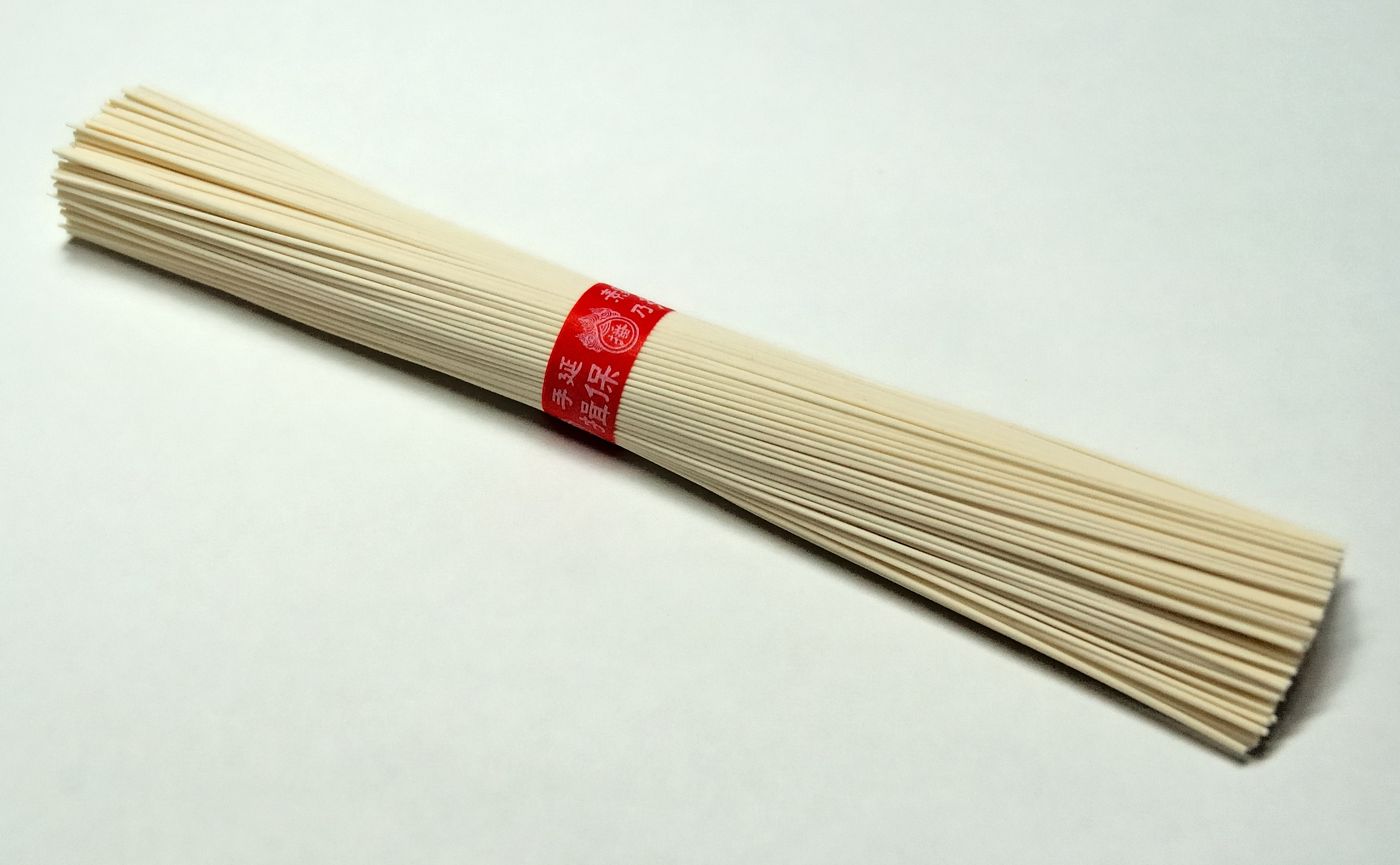 Photo: Kropsoq, CC BY-SA 3.0, via Wikimedia Commons
Origin & History
Somyeon is a fine, dried noodle made from wheat flour, salt and water. In the Korean Food Composition Table it sits in the noodle family as guksu, somyeon, and the dried bundles found in every Korean pantry are the descendants of a long, slow history of wheat noodles on the peninsula.
Noodles were known in Goryeo. A twelfth-century Chinese envoy praised them as the best of the dishes he was served, and the Goryeosa mentions noodles used in rites and sold by temples. Because wheat was scarce, though, noodles made from it were a festive food. The Encyclopedia of Korean Culture explains that wheat noodles carried symbolic meanings at Joseon celebrations. At a first birthday they wished the child good fortune. At a wedding the long strands stood for a couple's harmony and a marriage that would stretch on and on. At a sixtieth-birthday feast they wished for long life. That is the origin of janchi-guksu, literally "party noodles" (see janchi-guksu).
Dried wheat noodles became ordinary only in the twentieth century. Rotary-press noodle machines developed after 1900 made dried noodles possible to produce in quantity, and after 1945 abundant imported flour turned wheat noodle dishes into everyday food (see noodles in Korean history). Today somyeon is boiled, rinsed in cold water until the starch is gone and the strands are springy, then coiled into neat portions — topped with hot broth and garnishes for janchi-guksu, or tossed with seasonings for bibim-guksu.
Nutrition
| Calories | 370 kcal |
|---|---|
| Protein | 10.36 g |
| Fat | 1.27 g |
| Carbohydrates | 74.88 g |
| Fiber | 1.9 g |
| Sodium | 1274 mg |
Notable forSelenium (43.1 µg) · Sodium (1,274 mg)
Values copied from the Korean Food Composition Table (Rural Development Administration / National Institute of Crop Science) for this exact food, per 100 g edible portion. The salt in the dough mostly leaches into the cooking water: the table's entry for boiled somyeon lists 126 kcal and only 68 mg sodium per 100 g. The salt in a finished bowl comes mainly from the broth and sauce. Actual values vary with ingredients, portion size and preparation.
Health Benefits
- Quick energy, light on fat: Dried somyeon is mostly starch with moderate protein and very little fat, per the Korean Food Composition Table.
- Salt mostly boils off: Dried noodles are salty, but boiled somyeon lists only 68 mg sodium per 100 g. Rinsing well and going easy on broth and sauce keeps a bowl moderate.
- Contains gluten: Wheat noodles are off-limits for people with celiac disease, according to NIDDK; Korean buckwheat noodles often contain wheat too.
- Major allergen: Wheat is one of the nine major food allergens the U.S. FDA requires on labels.
Informational, not medical advice. Talk to a qualified professional about your own health and diet.
Sources
- 01국수 (Guksu, noodles) — Encyclopedia of Korean Culture
- 02밀국수 (Wheat noodles) — Encyclopedia of Korean Culture
- 03Korean Food Composition Table — Noodle, Somyeon, Dry noodle
- 04Korean Food Composition Table — Noodle, Somyeon, Dry noodle, Boiled
- 05Eating, Diet, & Nutrition for Celiac Disease — NIDDK
- 06Food Allergies — U.S. Food and Drug Administration