Ingredient
Gomchwi (Fischer's ragwort)
곰취
Romanization: gomchwi
A broad, heart-shaped mountain green with a bright, resinous perfume. In spring its large leaves wrap rice and grilled pork, and it is pickled in soy sauce as a keeping banchan.
Flavor
Fresh, green and distinctly aromatic, with a faintly bitter, piney edge and a mild sweetness. Young spring leaves are soft and pliable; summer leaves turn tough and stronger in taste.
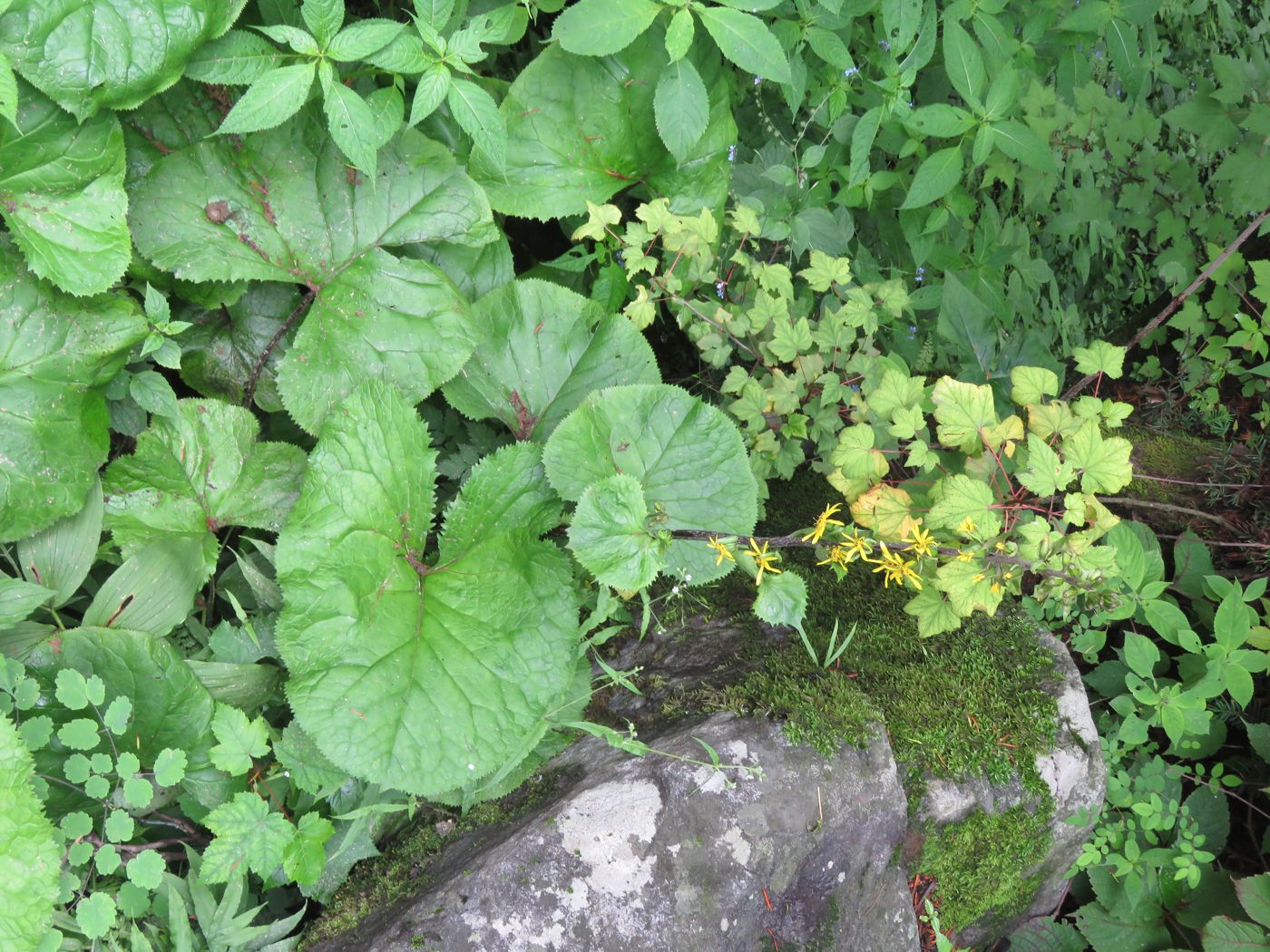 Photo: Vinayaraj, CC BY-SA 4.0, via Wikimedia Commons
Origin & History
Gomchwi is Fischer's ragwort (Ligularia fischeri), a perennial of the daisy family. The Encyclopedia of Korean Culture explains that the name means a green that bears are fond of, and gives the older name ungso, literally bear vegetable. Its basal leaves are kidney- to heart-shaped with regular teeth and long stalks; yellow flowers appear in clustered spikes from July to September. Of the roughly ten species in the genus across Europe and Asia, the encyclopedia counts nine in Korea.
Gomchwi has been gathered as a mountain green (sannamul) for a long time, and in the lean weeks of spring it also served as famine food. The encyclopedia points to a Joseon farming-calendar poem that praises fragrant gomchwi picked after rain and wrapped around rice, and notes that the cookbook Siui jeonseo and the compendium Gosa sibijip both record gomchwi-ssam: leaves boiled or steamed, then used to wrap rice. See ssam culture.
Today most gomchwi is cultivated in the cool uplands of Gangwon. Yanggu county bills itself as the largest producer and holds a gomchwi festival every May, when the young leaves are at their most tender; according to the Korea Tourism Organization, most of the county's growers farm in Dong-myeon, where greenhouses now bring the first leaves to market from February. In Taebaek, gomchwi growing was encouraged as a rural revitalization project around 1990, and the local leaf, sold as Taegom, is registered as a forest-product geographical indication.
In the kitchen, the raw leaves are a favorite wrap for grilled pork, whose richness their aroma cuts. Leaves are also blanched and seasoned as namul, dried for winter, or pickled as gomchwi-jangajji. See jangajji pickling.
Nutrition
| Calories | 32 kcal |
|---|---|
| Protein | 2.64 g |
| Fat | 0.53 g |
| Carbohydrates | 5.87 g |
| Fiber | 4.1 g |
| Sodium | 2 mg |
Notable forVitamin K · Vitamin A (as beta-carotene) · Calcium · Potassium
Korean Food Composition Table entry "Fischer's ragwort (Gomchwi), Leaf, Raw" (취나물, 곰취, 생것): also 340.09 µg vitamin K, 3,092 µg beta-carotene (258 µg RAE vitamin A), 160 mg calcium, 470 mg potassium, 98 µg folate and 11.42 mg vitamin C per 100 g. Actual values vary with ingredients, portion size and preparation.
Health Benefits
- Leafy green: Per the Korean Food Composition Table, raw gomchwi is low in calories and a source of fiber, beta-carotene, calcium, potassium and folate.
- Traditional beliefs: Regional promotion credits gomchwi with everything from easing fatigue to soothing coughs. These are folk claims, not established effects of eating it.
- Vitamin K and warfarin: Gomchwi is very high in vitamin K. MedlinePlus advises people taking warfarin to eat consistent amounts of vitamin K–containing foods from week to week and to avoid large amounts of leafy greens; ask your doctor before changing your diet.
- Don't forage blind: Wild gomchwi grows alongside toxic plants with similar round, heart-shaped leaves, such as dongui-namul (marsh marigold), which regional references describe as poisonous. Buy cultivated leaves unless you are with an experienced forager.
- Pickles add salt: Gomchwi-jangajji and seasoned namul carry most of their sodium from the pickling liquid and seasoning; see sodium in Korean food.
Informational, not medical advice. Talk to a qualified professional about your own health and diet.
Dishes with Gomchwi (Fischer's ragwort)
Dish guides featuring gomchwi (fischer's ragwort) are coming soon.
Sources
- 01곰취 — Encyclopedia of Korean Culture
- 025월, 양구는 '아삭아삭' 곰취 천국 — 대한민국 구석구석 (Korea Tourism Organization)
- 03청춘양구 곰취축제 — 대한민국 구석구석 (Korea Tourism Organization)
- 04“스마트농업타운으로 태백농업 재도약” — 농촌여성신문
- 05Korean Food Composition Table: Fischer's ragwort (Gomchwi), Leaf, Raw — National Institute of Agricultural Sciences
- 06Warfarin — MedlinePlus Drug Information