Ingredient
Spoon worm (gaebul)
개불
Romanization: gaebul
A plump, pink marine worm that burrows in the sandy mud of the south and west coasts. It is a winter delicacy, sliced raw for its crunchy, sweet chew or tossed with vinegared chili paste.
Flavor
Mildly sweet and briny with a clean sea taste; the texture is the point, crunchy and springy when raw, turning chewy and rubbery if overcooked.
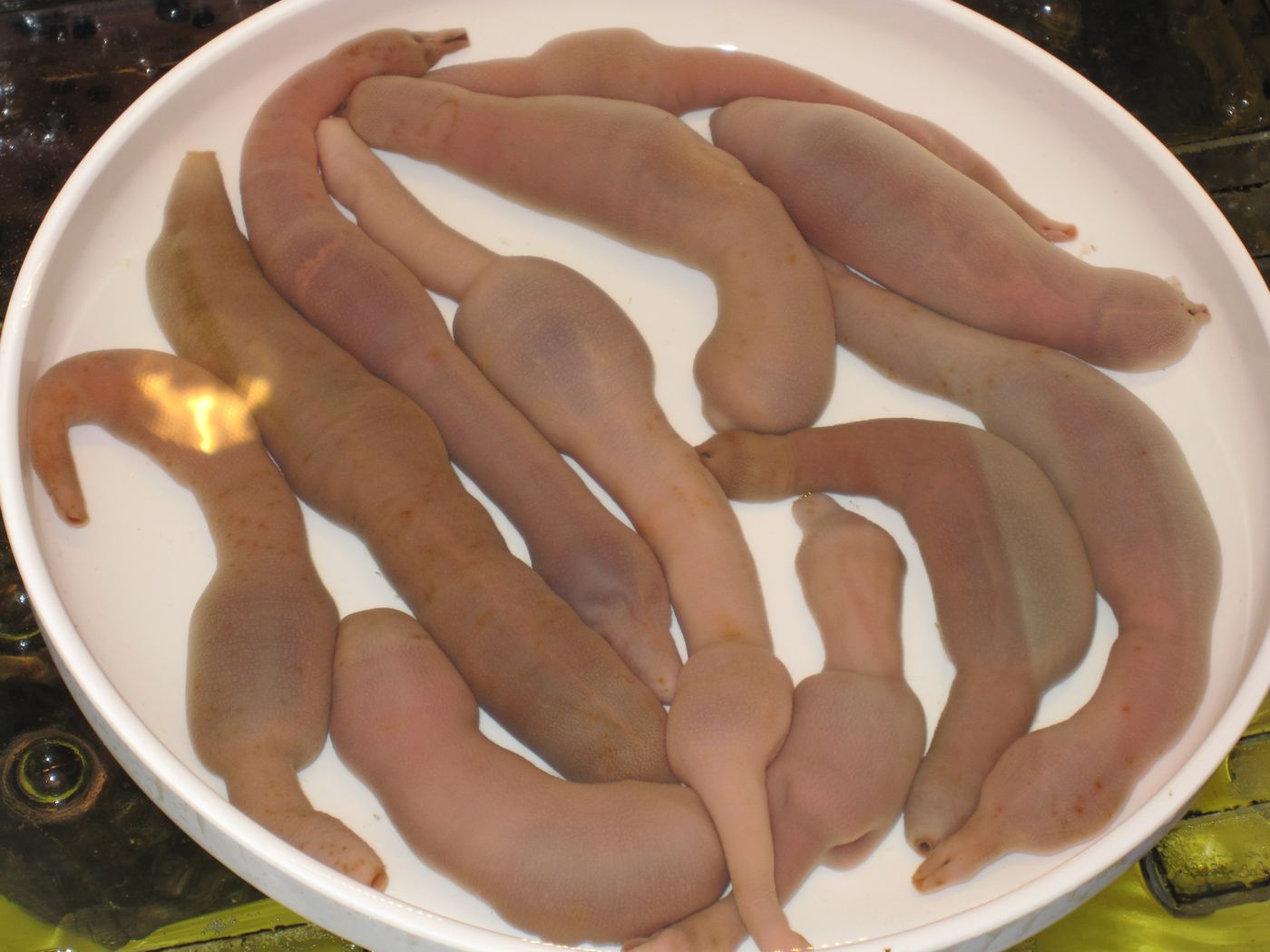 Photo: J. Patrick Fischer, CC BY-SA 3.0, via Wikimedia Commons
Origin & History
Gaebul is Urechis unicinctus, a spoon worm: an unsegmented marine animal belonging to the echiurans, which the Encyclopedia of Korean Culture describes as a strange group of about 135 species worldwide. The body is 10–30 cm long, soft, and pinkish-white when alive, dotted with small bumps and ringed with bristles near the rear. It digs a U-shaped burrow in sandy mud, from the intertidal zone down to about 100 m, and in Korea is found south of the central coasts; it also lives off Japan. Its blunt Korean name is a frank description of its shape, which the Encyclopedia of Korean Folk Culture compares to a dog's testicles. Beyond the table it has long been used as fishing bait for sea bream and flounder.
The catch is a winter one. According to the folk encyclopedia, gaebul is harvested from November to February, when the water is cold. Along the South Jeolla and South Gyeongsang coasts, small boats drag a row of curved iron hooks across the sea floor, using a sea anchor rather than the engine to keep the speed steady so the worms are not torn. On the mudflats, people dig them out by hand at low tide, finding the two holes of each burrow and following them down with a shovel or rake. In Sacho-ri in Gangjin, villagers work in pairs, men churning the mud with short forks and women scooping up the worms, and they harvest only every other year to protect the stock. A hand-pump device that sucked worms out of their burrows caused overharvesting on the west coast and was banned in June 2021.
Gaebul was once cheap and little regarded; the folk encyclopedia notes that in Gangjin it gained commercial value nationwide only in the mid-2000s. Today it is a familiar sight in seafood-market tanks. Cleaned and cut into rings, it is eaten raw as gaebul-hoe dipped in chogochujang, tossed into a tangy chomuchim, or quickly stir-fried, and it sits on the same platters as sea squirt, haesam and other raw shellfish in hoe culture.
Nutrition
| Calories | 53 kcal |
|---|---|
| Protein | 10.5 g |
| Fat | 0.2 g |
| Carbohydrates | 1.6 g |
| Fiber | 0 g |
| Sodium | Not reported |
Notable forIron (5.5 mg) · Phosphorus (144 mg) · Niacin (2.2 mg)
Values copied from the Korean Food Composition Table (Rural Development Administration / National Institute of Crop Science) for this exact food, per 100 g edible portion. Blank fields in the table are shown as not reported. Actual values vary with ingredients, portion size and preparation.
Health Benefits
- Lean protein with iron: Raw gaebul has about 53 kcal, 10.5 g of protein and almost no fat per 100 g in the Korean table, with 5.5 mg of iron.
- Raw seafood: Gaebul is usually eaten raw. The FDA advises pregnant women, young children, older adults and people with weakened immunity to avoid raw or undercooked seafood, and recommends buying from reputable sources.
- Allergies: Spoon worms are not fish, crustaceans or mollusks and are not among the nine U.S. major food allergens; people with seafood allergies who are unsure should consult an allergist.
- Watch the dip: Chogochujang and seasoned dressings add sugar and sodium to an otherwise lean food.
Informational, not medical advice. Talk to a qualified professional about your own health and diet.
Dishes with Spoon worm (gaebul)
Dish guides featuring spoon worm (gaebul) are coming soon.
Sources
- 01개불 (Spoon worm) — Encyclopedia of Korean Culture
- 02개불잡이 (Spoon worm fishing) — Encyclopedia of Korean Folk Culture, National Folk Museum of Korea
- 03[지금이 제철] 못생겨도 맛은 일품, 제철 '개불' (In season: spoon worm) — MBC News (2016)
- 04Korean Food Composition Table — Urechis unicinctus, Raw
- 05Selecting and Serving Fresh and Frozen Seafood Safely — U.S. Food and Drug Administration
- 06Food Allergies — U.S. Food and Drug Administration