Ingredient
Sea cucumber (haesam)
해삼
Romanization: haesam
A soft-bodied echinoderm eaten raw with vinegared chili paste in Korea and, once dried, treated as a luxury that appeared on Joseon royal banquet tables. Its name means "sea ginseng."
Flavor
Nearly neutral in taste, faintly briny and sea-fresh; prized for texture, crisp and crunchy when raw, gelatinous and springy once dried and rehydrated, readily taking on the flavor of a sauce.
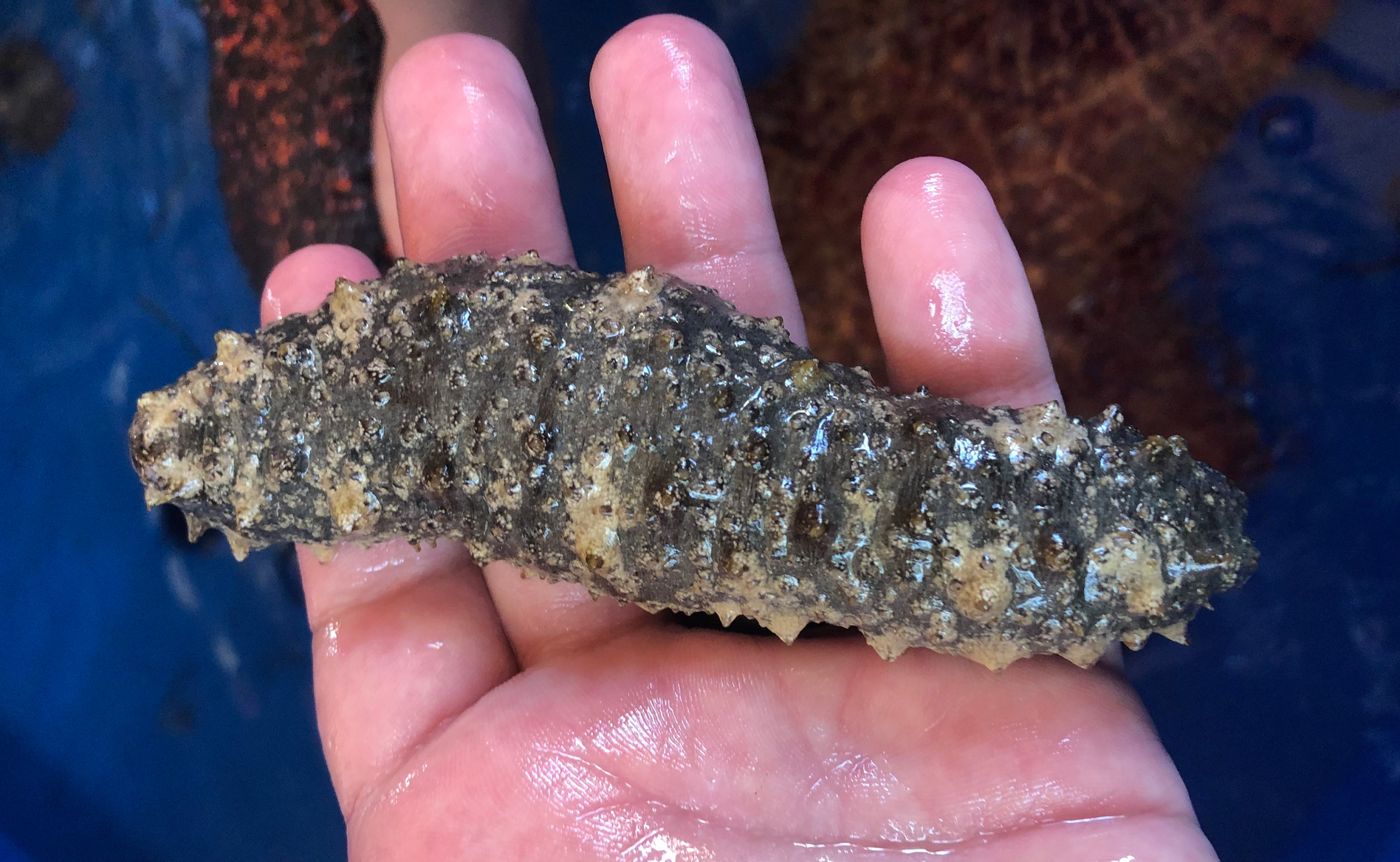 Photo: seanpmyers, CC0, via Wikimedia Commons
Origin & History
Haesam is the general name for the sea cucumbers. Though they look like soft mollusks, they are echinoderms, relatives of sea urchins and starfish, with a cucumber-shaped body, a mouth at one end ringed by feeding tentacles, and a habit of swallowing sand or mud and digesting its organic matter. The edible species is found in all Korean waters. Joseon reference books called it toyuk ("earth flesh") and gave the native word mwi; the name haesam ("sea ginseng") was explained in Seo Yu-gu's Jeoneoji, which said that its strengthening effect rivals that of ginseng. The folk encyclopedia notes that Jeju sea cucumbers tend to be the large, red-bellied, knobbly hong-haesam, while those of the peninsula's coasts are mostly the dark heuk-haesam, a difference thought to reflect habitat and diet rather than nutrition. They are active in the cold months and retreat to deeper water in summer, when divers say the sea cucumbers have "melted."
Dried sea cucumber was a trade good long before refrigeration. Jasan eobo observed that every Korean sea produced it, that it was dried and sold everywhere, and that it was counted with abalone and mussels as the "three goods" of the sea. Dried and soaked back to softness, it became a luxury ingredient. The Joseon household manual Gyuhap chongseo uses it in the elaborate hot pot yeolgujatang and in eochae, and court banquet records list it in quantity: the 1848 Musin jinchan uigwe records a towering platter of braised abalone and haesam-jeon (soaked dried sea cucumbers stuffed with meat and tofu, then pan-fried) for a palace feast, calling for 250 sea cucumbers, and the 1902 Imin jinyeon uigwe lists 300 for a single dish of haesam-jeon served to Emperor Gojong (see royal banquets).
Everyday eating is simpler. Most Koreans eat fresh sea cucumber raw, cut into crunchy pieces and dipped in vinegared gochujang. On Jeju it goes into cold mulhoe seasoned with doenjang and vinegar, or is blanched until tender (haesam-toryeom) for elders and children with weak teeth. The thread-like innards are eaten separately, raw, or salted into jeotgal.
Nutrition
| Calories | 24 kcal |
|---|---|
| Protein | 3.7 g |
| Fat | 0.4 g |
| Carbohydrates | 1.3 g |
| Fiber | 0 g |
| Sodium | 1300 mg |
Notable forCalcium (119 mg) · Iron (2.1 mg)
Values copied from the Korean Food Composition Table (Rural Development Administration / National Institute of Crop Science) for this exact food, per 100 g edible portion. Blank fields in the table are shown as not reported. The high sodium reflects the seawater held in the raw body. Dried sea cucumber (해삼, 말린것) is very different: 331 kcal, 77.6 g protein, 1,384 mg calcium, 53 mg iron and 2,842 mg sodium per 100 g before soaking. Actual values vary with ingredients, portion size and preparation.
Health Benefits
- Very low in calories: Raw sea cucumber has about 24 kcal and under half a gram of fat per 100 g in the Korean table, with 119 mg of calcium.
- Sodium: The same table lists 1,300 mg of sodium per 100 g of raw sea cucumber, and it is usually eaten with salty or sweet-spicy dips; people limiting sodium should keep portions modest.
- Traditionally valued: Joseon writers likened its strengthening power to ginseng, and Jeju folk practice used it as a remedy for asthma; these are traditional beliefs, not proven medical effects, and research on sea cucumber compounds is ongoing.
- Raw seafood and allergies: The FDA advises at-risk groups (pregnant women, young children, older adults, people with weakened immunity) to avoid raw seafood. Sea cucumbers are echinoderms and are not among the nine U.S. major food allergens; people with seafood allergies should ask an allergist.
Informational, not medical advice. Talk to a qualified professional about your own health and diet.
Dishes with Sea cucumber (haesam)
Dish guides featuring sea cucumber (haesam) are coming soon.
Sources
- 01해삼 (Sea cucumber) — Encyclopedia of Korean Culture
- 02해삼 (Sea cucumber) — Encyclopedia of Korean Folk Culture, National Folk Museum of Korea
- 03전복초-해삼전 (Braised abalone and stuffed sea cucumber, 1848 Musin jinchan uigwe) — Academy of Korean Studies digital humanities wiki
- 04해삼전 (Stuffed sea cucumber jeon, 1902 Imin jinyeon uigwe) — Academy of Korean Studies digital humanities wiki
- 05Korean Food Composition Table — Sea cucumber, Raw
- 06Selecting and Serving Fresh and Frozen Seafood Safely — U.S. Food and Drug Administration