History & Culture
Sujeo: Korea's Spoon and Chopsticks
수저
Why Koreans eat rice with a spoon, why their chopsticks are metal and flat, and how the paired sujeo set grew from Baekje bronze to stainless steel.
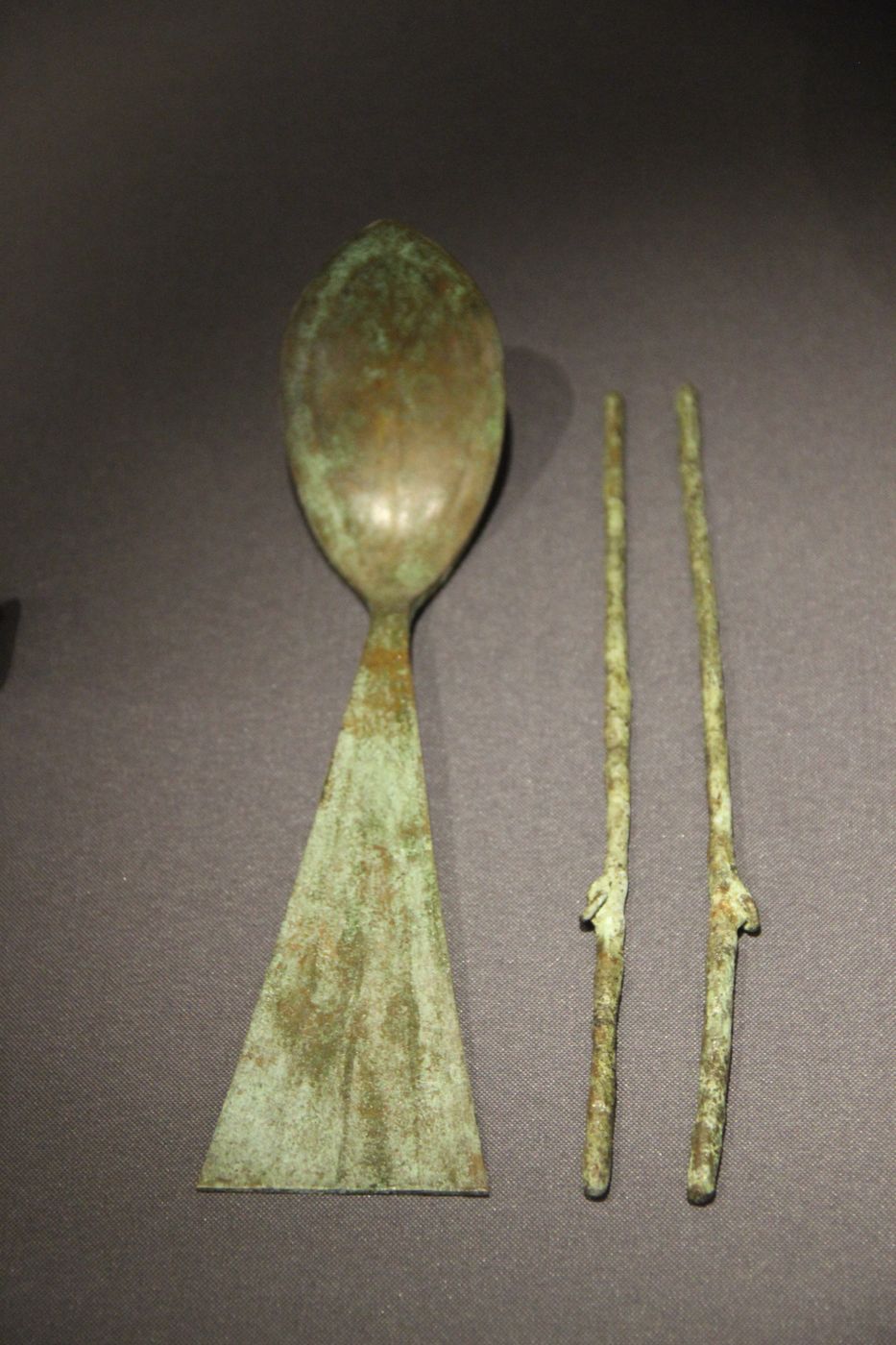 Photo: Gary Todd from Xinzheng, China, CC0, via Wikimedia Commons
Sujeo (수저) is the Korean word for a matched spoon and pair of chopsticks, a contraction of sutgarak (spoon) and jeotgarak (chopsticks). Elsewhere in East Asia the spoon has largely dropped out of the everyday meal, leaving chopsticks to do most of the work. In Korea the two stayed together, and the spoon, not the chopsticks, remains the main utensil.
An old pairing
According to the Encyclopedia of Korean Culture, the oldest spoon found in Korea is a bone implement from a Bronze Age shell mound on Chodo island near Najin, in today's North Korea. The oldest known Korean chopsticks are bronze pairs from the tomb of King Muryeong of Baekje (r. 501–523), excavated at Gongju; a JoongAng Daily report on the finds describes them as flat, about 21 and 20 centimeters long, with rings for attaching a chain. Chopsticks appear later than spoons in Chinese records too, which suggests they developed second.
The same encyclopedia dates the use of spoon and chopsticks together to the Three Kingdoms period. China and Japan also once used both, but gradually came to rely on chopsticks alone. The encyclopedia explains Korea's different path by the structure of the meal: the everyday table always paired foods with broth, guk, jjigae and watery kimchi, with dry side dishes, so both tools stayed useful. How widely ordinary people used chopsticks in earlier centuries is less clear. The JoongAng Daily report cites the view that, in early and mid-Joseon, chopsticks were largely an upper-class utensil and many commoners ate with a spoon alone, a claim that sits alongside rather than against the long history of the paired set at court and among the elite.
Bronze, brass, silver and steel
Early sujeo were mostly bronze, followed by brass, nickel silver and silver. Their shape changed over time. Early Goryeo spoons had strongly curved handles, and mid-Goryeo handles ended in a split swallowtail. By early Joseon the swallowtail had gone, the handle had straightened and the bowl had become a leaf-shaped oval; later the handle grew longer and thicker and the bowl rounder, while chopsticks tapered at one end toward their present form. Handles were often inlaid with characters for luck or flowers in cloisonné.
Brass spoons of the highest quality were made by bangjja, forging rather than casting. In the Gangneung workshop recognized as a provincial intangible heritage in 2003, copper and tin are melted together, cast into finger-length bars and then heated and hammered repeatedly, with more than fifteen rounds of heating and quenching, until the metal is dense and lustrous. Royal households favored silver, partly for its supposed ability to reveal poison. That belief is only partly true, since silver discolors on contact with some toxic substances but not others.
Why flat steel chopsticks?
Today's typical Korean chopsticks are stainless steel and flat or oval in section. This style is modern. Stainless steel spoons, chopsticks and rice bowls spread from the 1960s as industry recovered after the Korean War: they were cheap, durable and easy to clean. A cutlery maker quoted by the JoongAng Daily explains the flat shape as the most efficient to stamp from sheet metal in mass production, and the same report says that the Park Chung-hee government discouraged disposable wooden chopsticks. Explanations rooted in a single cause, whether royal silver, hygiene or grilling over charcoal, are best treated as partial; the metal set reflects centuries of habit as well as the economics of the industrial era. Fine metal tips are also well suited to picking up slippery namul, beans and small fish, as on a table of shared banchan.
Table manners
Traditional etiquette follows from the spoon's importance. The Encyclopedia of Korean Culture states that rice as well as soup is properly eaten with the spoon; that once the spoon is picked up it should not be put down on the table until the meal is over; that it rests across the rice or soup bowl while chopsticks are in use; and that chopsticks are for side dishes. Today the common rules are to wait for the eldest at the table to begin, to leave the rice bowl on the table rather than lifting it, not to hold spoon and chopsticks in one hand at the same time, and never to stand chopsticks or a spoon upright in rice, which recalls the way a spoon is set into the rice bowl at an ancestral rite. For how the rite table itself is set, see jesa food.
A set for life
Sujeo carried personal meaning. A child traditionally received a first personal set on the first birthday, moved up to larger sizes with age, and at marriage the bride prepared a set for herself and her husband, along with rice and soup bowls, that might last most of a lifetime. Households kept separate sets for guests. The habit of personal utensils fits the older individual table described in Korean table settings.