Ingredient
Myeongi (Ulleungdo Wild Garlic, Alpine Leek)
명이나물
Romanization: myeongi-namul
The broad, garlicky leaves of a wild mountain allium, best known from Ulleungdo. They are eaten fresh in wraps or pickled in soy brine, and the early-spring season is short.
Flavor
Pungent and garlicky, with a clean green edge and a tender chew. Fresh leaves are sharper; soy pickles mellow the bite and turn salty-sweet, a good counterweight to fatty meat.
Origin & History
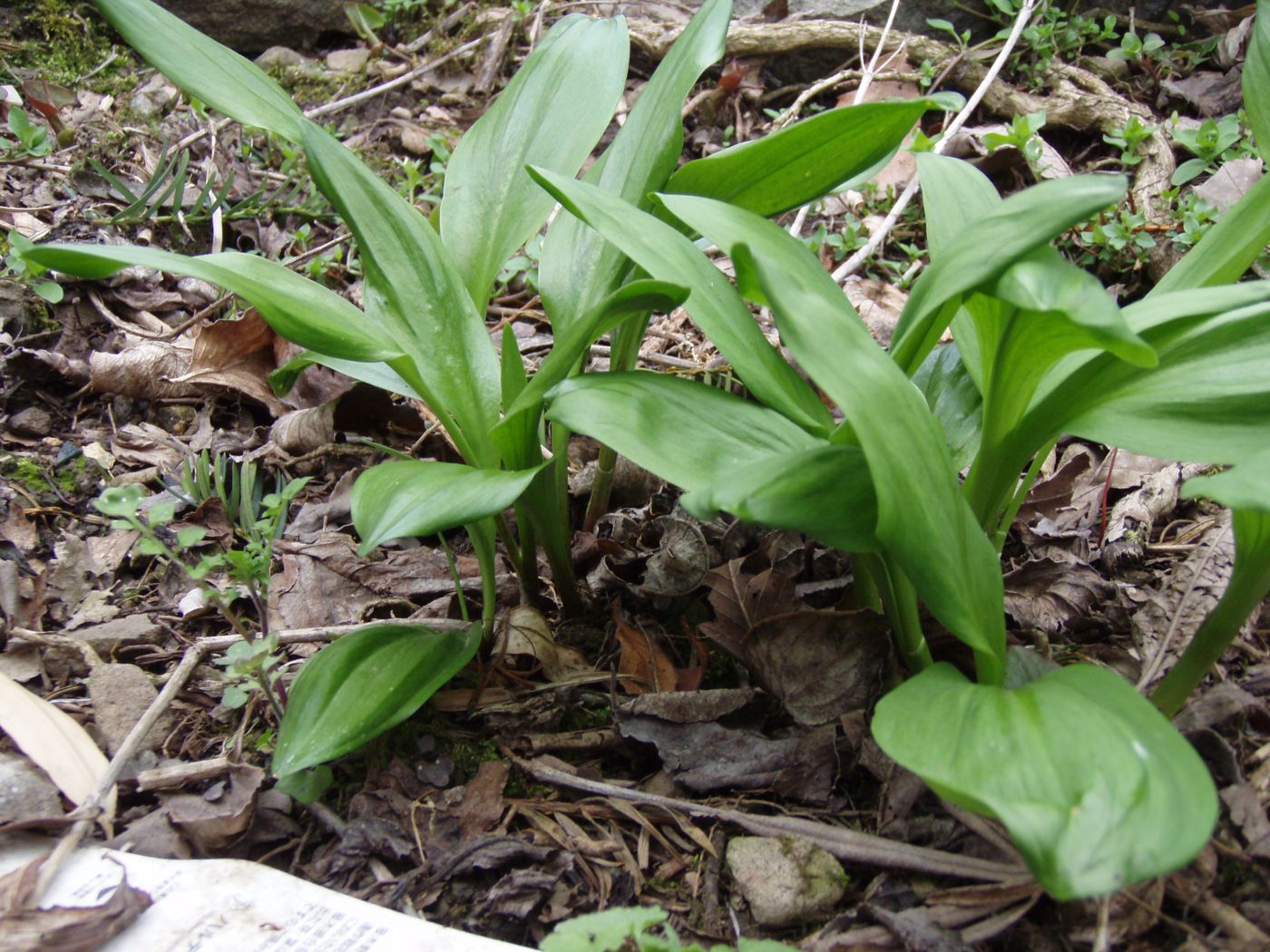
Myeongi-namul is the Ulleungdo name for what most of Korea calls san-maneul ('mountain garlic'), an allium with broad leaves and a strong garlic-chive smell. A story told on the island, reported by the Seoul Shinmun, says settlers who arrived after the 1882 order opening the island found the plant under the snow and survived on it, and that the name comes from this. The Korea Forest Service calls the plant san-maneul and notes it is widely known as myeongi-namul.
Botanists have debated what exactly grows where. A 2023 PLOS ONE study examines three similar species: Allium ulleungense, recently recognized as endemic to Ulleung Island; A. microdictyon, found from Siberia to Mongolia and Korea; and A. ochotense, found in Japan, northeast China, southeast Russia and North Korea. The authors say the three look so alike that they are hard to tell apart in fields and markets, and they found that some cultivated collections appear to be hybrids. So 'myeongi' is partly a local and culinary name, and which species is in a given bag is not always clear. English names include alpine leek and Siberian garlic.
Today myeongi is farmed on the mainland as well as gathered wild on the island. The Seoul Shinmun reported in 2024 that cultivation had spread to Chungju, Hongcheon, Pyeongchang, Inje, Sangju, Yeongju, Yecheon and Sancheong after roots and seeds left the island, cutting into Ulleungdo growers' sales. The Forest Service named san-maneul its 'forest product of the month' for April 2026, describing it as a spring crop picked right after the snow melts and used in wraps and pickles, and advising harvesters to leave at least one leaf on each plant so that it can regrow. Fresh leaves serve as a ssam wrap (see ssam culture), and the best-known preparation is jangajji, pickled in soy-based brine; see jangajji pickling.
Nutrition
| Calories | 36 kcal |
|---|---|
| Protein | 2.02 g |
| Fat | 0.21 g |
| Carbohydrates | 8.21 g |
| Fiber | 4.1 g |
| Sodium | 0 mg |
Notable forVitamin C (62.63 mg) · Dietary fiber · Potassium (309 mg) · Manganese (2.241 mg)
Values copied from the Korean Food Composition Table (Rural Development Administration / National Institute of Crop Science) for this exact food, per 100 g edible portion. Blank fields in the table are shown as not reported. The table lists sodium as 0 for the raw leaf. It has a separate entry for the pickle (산마늘장아찌), which is far saltier. Actual values vary with ingredients, portion size and preparation.
Health Benefits
- Vitamin C and fiber: The Korean Food Composition Table lists about 63 mg of vitamin C and 4.1 g of fiber per 100 g raw, plus 210 µg of vitamin A.
- Official description: The Korea Forest Service describes the leaves as containing allicin, vitamins A and C and fiber, and links them with circulation, immunity and gut health. These are general claims reported by the agency, not findings from a study of eating myeongi.
- Research on the genus: The PLOS ONE authors note that earlier studies have linked these wild alliums to anti-cancer, anti-inflammatory and antioxidant effects. That does not show benefits from eating a side dish.
- Poisonous look-alikes: The Korea National Arboretum warns that lily of the valley (eunbangulkkot), which is poisonous, has two young leaves like san-maneul. San-maneul smells of chives; lily of the valley has no smell, stiffer leaves and thinner roots. Do not forage unless you can identify the plant with certainty.
- Sodium in pickles: Soy-brine jangajji is salty. Eat it in small portions if you are watching sodium; see sodium in Korean food.
- Wild harvest: The Forest Service advises leaving at least one leaf on each plant when harvesting.
Informational, not medical advice. Talk to a qualified professional about your own health and diet.
Dishes with Myeongi (Ulleungdo Wild Garlic, Alpine Leek)
Dish guides featuring myeongi (ulleungdo wild garlic, alpine leek) are coming soon.
Sources
- 01명이나물까지 육지에 빼앗겼네… 울릉도 특산 산나물 농가 ‘비상’ — 서울신문 (2024-04-03)
- 02명이나물로 유명한 ‘산마늘’, 이달의 임산물에 선정 — 헤럴드경제 (2026-04-14)
- 03Authentication of Allium ulleungense, A. microdictyon and A. ochotense based on super-barcoding of plastid genome and 45S nrDNA — PLOS ONE (2023)
- 04산나물, ‘알면 약초·모르면 독초’ — 서울신문 (2020-03-31)
- 05산마늘(명이나물), 생것 (Alpine leek, raw) — Korean Food Composition Table, RDA