Ingredient
Warty sea squirt (mideodeok)
미더덕
Romanization: mideodeok
A small, stalked sea squirt farmed in Jindong Bay near Masan. Its crunchy, briny pouch bursts with sea-scented liquid and flavors doenjang stews and Masan's braised dishes.
Flavor
Strongly oceanic and slightly sweet-bitter, with a crisp, crunchy shell and a burst of salty, iodine-scented liquid; it perfumes a whole pot.
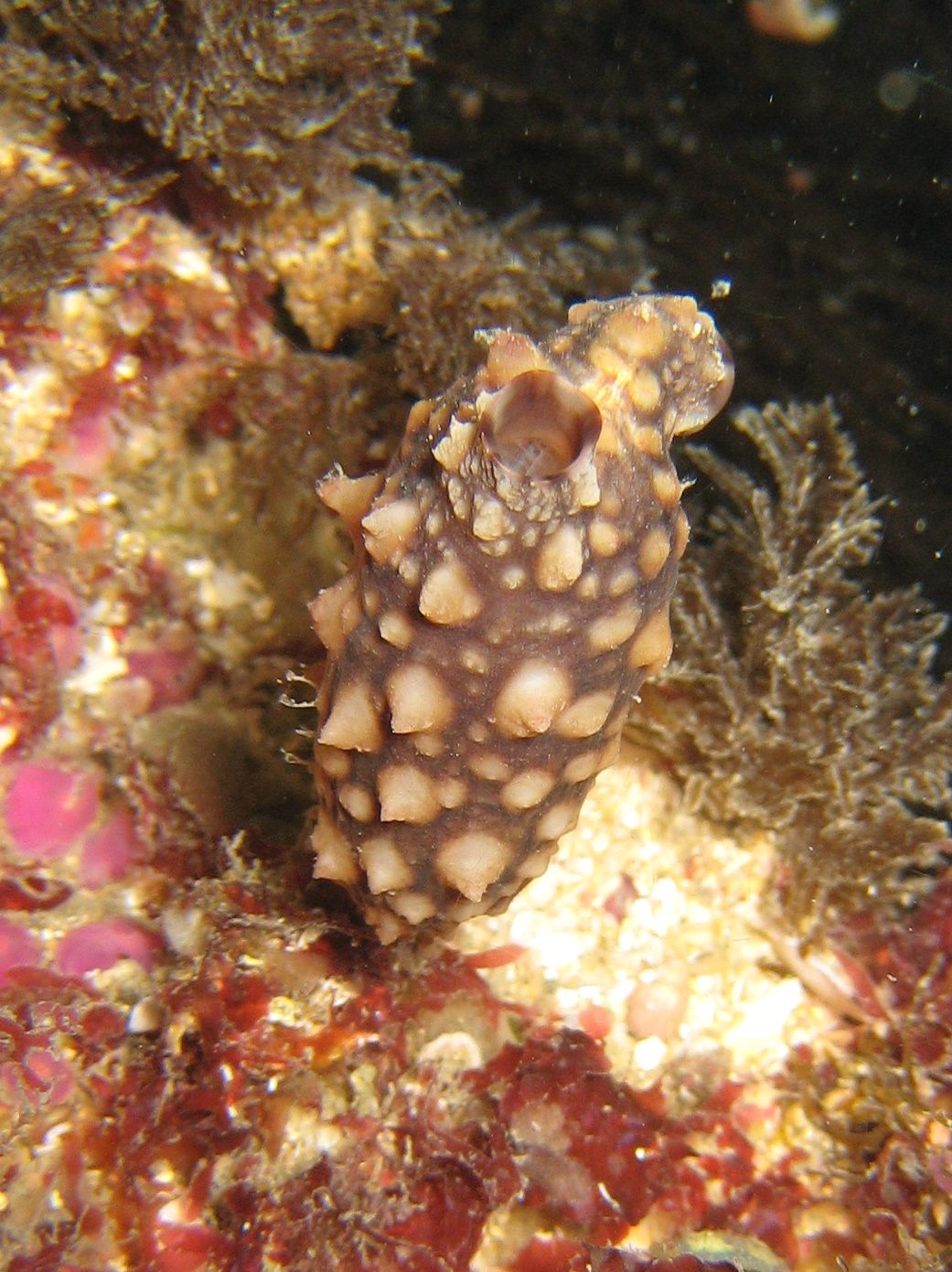 Photo: This photo has been taken by Matthieu Sontag (User:Mirgolth) and released under, CC BY-SA 3.0, via Wikimedia Commons
Origin & History
Mideodeok is Styela clava, a tunicate (a filter-feeding sea squirt, not a mollusk) 5–10 cm long, with a tough, knobbly yellow-brown outer tunic and a stalk it uses to cling to rocks, ropes and hulls. The Encyclopedia of Korean Folk Culture explains the name: mi is an old word for water, so mideodeok is "water deodeok," after the bumpy mountain root it resembles. It is often confused with omandungi, the wrinkled sea squirt, which has no stalk, grows quickly on almost any surface and is eaten year-round with its skin on. Mideodeok, by contrast, is peeled before cooking and is best in spring; fishers in Jindong Bay call it cham-mideodeok, "true mideodeok."
Because it fouls boats and shellfish farms, mideodeok was long treated as a pest, and licensed farming came late: the folk encyclopedia dates the start of farming to 1990, with a big expansion after hatchery seeding succeeded in 2010. Jindong Bay in Masanhappo-gu, Changwon, now supplies about 70 percent of the national harvest, and Jindong mideodeok is registered as a fisheries geographical indication. Recent summers have been hard on it. A 2026 Busan Ilbo report from Gohyeon village recorded a fall in output from 2,689 tons in 2021 to 136 tons in 2025, with growers blaming heat waves and low-oxygen water; the local festival has been cancelled several years running.
Mideodeok's main job in the kitchen is to make a broth taste siwonhada, clean and refreshing. A handful goes into doenjang-jjigae and soybean-sprout soup, and it is also eaten raw or tossed with vinegared chili paste. Masan's braised mideodeok-jjim is a celebrated local dish, and the Encyclopedia of Korean Folk Culture notes that cooks add mideodeok to Masan's dried-monkfish agu-jjim to perfume it and cover any fishiness.
Nutrition
| Calories | 44 kcal |
|---|---|
| Protein | 4.3 g |
| Fat | 1.2 g |
| Carbohydrates | 4.1 g |
| Fiber | 0 g |
| Sodium | Not reported |
Notable forIron (3.2 mg) · Phosphorus (111 mg)
Values copied from the Korean Food Composition Table (Rural Development Administration / National Institute of Crop Science) for this exact food, per 100 g edible portion. Blank fields in the table are shown as not reported. The wrinkled sea squirt (omandungi) is listed separately (미더덕, 주름미더덕, 생것). Actual values vary with ingredients, portion size and preparation.
Health Benefits
- Low in calories: Raw mideodeok has about 44 kcal per 100 g in the Korean table, with some iron (3.2 mg).
- Mostly a flavoring: It is used a handful at a time to season stews and braises, so its nutritional contribution to a meal is small.
- Not a mollusk: Sea squirts are tunicates, not fish or shellfish, and are not among the U.S. major food allergens; anyone with seafood allergies who reacts to them should seek an allergist's advice.
- Raw seafood: When eaten raw, the FDA's general advice applies: thorough cooking is safest, and at-risk groups should avoid raw or undercooked seafood.
Informational, not medical advice. Talk to a qualified professional about your own health and diet.
Sources
- 01미더덕 (Warty sea squirt) — Encyclopedia of Korean Culture
- 02미더덕 (Warty sea squirt) — Encyclopedia of Korean Folk Culture, National Folk Museum of Korea
- 03마산아귀찜 (Masan agwi-jjim) — Encyclopedia of Korean Folk Culture, National Folk Museum of Korea
- 04[르포] 제철 맞은 미더덕 주산지, 손님 발길에도 '한숨' 왜? (Mideodeok harvest report) — Busan Ilbo via Daum (2026)
- 05Korean Food Composition Table — Warty sea squirt, Raw
- 06Selecting and Serving Fresh and Frozen Seafood Safely — U.S. Food and Drug Administration