Ingredient
Marsh clams (jaecheop)
재첩
Romanization: jaecheop
Tiny river clams raked by hand from the brackish lower Seomjin River at Hadong. Simmered with garlic chives into milky jaecheop-guk, they are a classic hangover soup of the south coast.
Flavor
Sweet, clean and gently briny, with a mild earthy-mineral edge; the broth is the main event, pale, savory and refreshing (*siwonhan*).
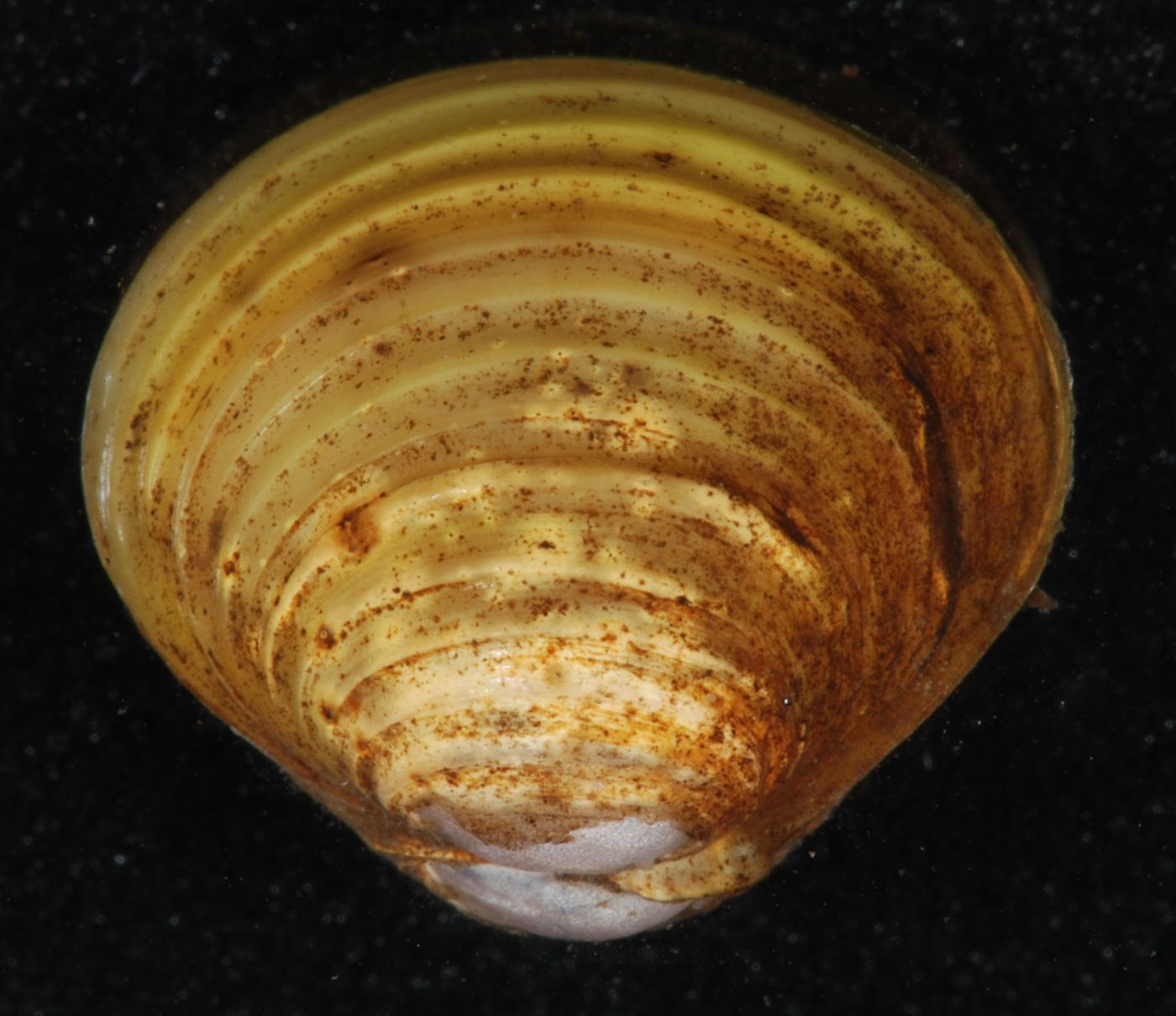 Photo: Smithsonian Environmental Research Center, CC BY 2.0, via Wikimedia Commons
Origin & History
Jaecheop are small corbicula clams, thick-shelled bivalves the size of a fingernail that live in sandy mud in clean rivers, lakes and estuaries where fresh and salt water mix. Korea has six species, and the shell ranges from yellowish to nearly black depending on the riverbed. Local names include gaengjogae, gamakjogae and jaechi. They overwinter deep in the sand and rise in warm weather; the Encyclopedia of Korean Folk Culture says they are most fragrant and plump around spawning in early summer. The Nakdong River estuary near Busan was once a major source, but industrial pollution from the 1970s and the completion of the Nakdong estuary barrage in 1987, which cut off the tide, wiped them out there. Today almost all Korean jaecheop come from the brackish lower reaches of the Seomjin River.
On the Seomjin, villagers in Hadong (South Gyeongsang) and Gwangyang (South Jeolla) wade into the river at low tide wearing a tub tied at the waist and drag a georaengi, a long bamboo-handled rake with a mesh basket, through the riverbed, feeling for clams with their feet and shaking the sand out through the mesh. The rakes are made to suit the user's height, strength and dominant hand, and set differently for summer and for spring and autumn, when the clams sit deeper. Harvesters sieve out small clams to protect the stock, work about 100 days a year around the spring tides, and stop for the July–August spawning. In November 2018 this hand-rake fishery was designated Korea's seventh National Important Fishery Heritage. In the 1950s the river was said to be "half water, half jaecheop."
The clams are purged of grit, boiled until the meat drops from the shells, and the strained broth is reheated with the meat, salt and chopped buchu to make jaecheop-guk: pale, milky and refreshing, and widely trusted as a hangover cure. Hadong restaurants serve it with rice and side dishes, sometimes with a bowl of rice to mix with bean sprouts and young-radish kimchi. In Busan, women once carried pots of it on their heads through the alleys at dawn, calling out in dialect for buyers of jaechi-guk; on the Seomjin, similar vendors worked until the early 1990s. Jaecheop is also tossed with vegetables and vinegared chili paste or folded into jeon.
Nutrition
| Calories | 94 kcal |
|---|---|
| Protein | 12.5 g |
| Fat | 1.9 g |
| Carbohydrates | 5.8 g |
| Fiber | 0 g |
| Sodium | 390 mg |
Notable forIron (21 mg) · Calcium (181 mg) · Phosphorus (213 mg)
Values copied from the Korean Food Composition Table (Rural Development Administration / National Institute of Crop Science) for this exact food, per 100 g edible portion. Blank fields in the table are shown as not reported. Actual values vary with ingredients, portion size and preparation.
Health Benefits
- Exceptionally rich in iron: Raw jaecheop meat lists 21 mg of iron per 100 g in the Korean table, along with 181 mg of calcium and 12.5 g of protein.
- Traditionally valued: Jaecheop-guk is widely believed to support the liver and ease hangovers; these are folk beliefs, not established medical effects, and the soup does not offset the effects of heavy drinking.
- Low mercury: The FDA/EPA advice on eating fish lists clams among its "Best Choices," the lowest-mercury group.
- Mollusk allergy: Clams are bivalve mollusks. U.S. law's major-allergen list covers crustacean shellfish but not mollusks, so labeling may differ; people with shellfish allergies should ask an allergist which kinds are safe.
- Cook thoroughly: The FDA says shellfish are safest thoroughly cooked; uncooked preparations carry more risk for at-risk groups.
Informational, not medical advice. Talk to a qualified professional about your own health and diet.
Dishes with Marsh clams (jaecheop)
Dish guides featuring marsh clams (jaecheop) are coming soon.
Sources
- 01재첩 (Marsh clam) — Encyclopedia of Korean Folk Culture, National Folk Museum of Korea
- 02재첩국 (Marsh clam soup) — Encyclopedia of Korean Folk Culture, National Folk Museum of Korea
- 03하동·광양 섬진강 재첩잡이 손틀어업 (Hand-rake marsh clam fishery of the Seomjin River) — Encyclopedia of Korean Folk Culture, National Folk Museum of Korea
- 04Korean Food Composition Table — Marsh clam, Raw
- 05Advice about Eating Fish — U.S. Food and Drug Administration / EPA
- 06Food Allergies — U.S. Food and Drug Administration