Ingredient
Sailfin sandfish (dorumuk)
도루묵
Romanization: dorumuk
A small, scaleless fish of the East Sea that comes inshore in early winter to spawn. Cooks prize the females for their roe and braise, grill or stew the whole fish. Its name comes from a well-known folktale.
Flavor
Mild, lean and clean tasting, with soft white flesh and little fishy smell. The roe is the highlight: it firms up and turns red when cooked and gives a gentle, starchy pop.
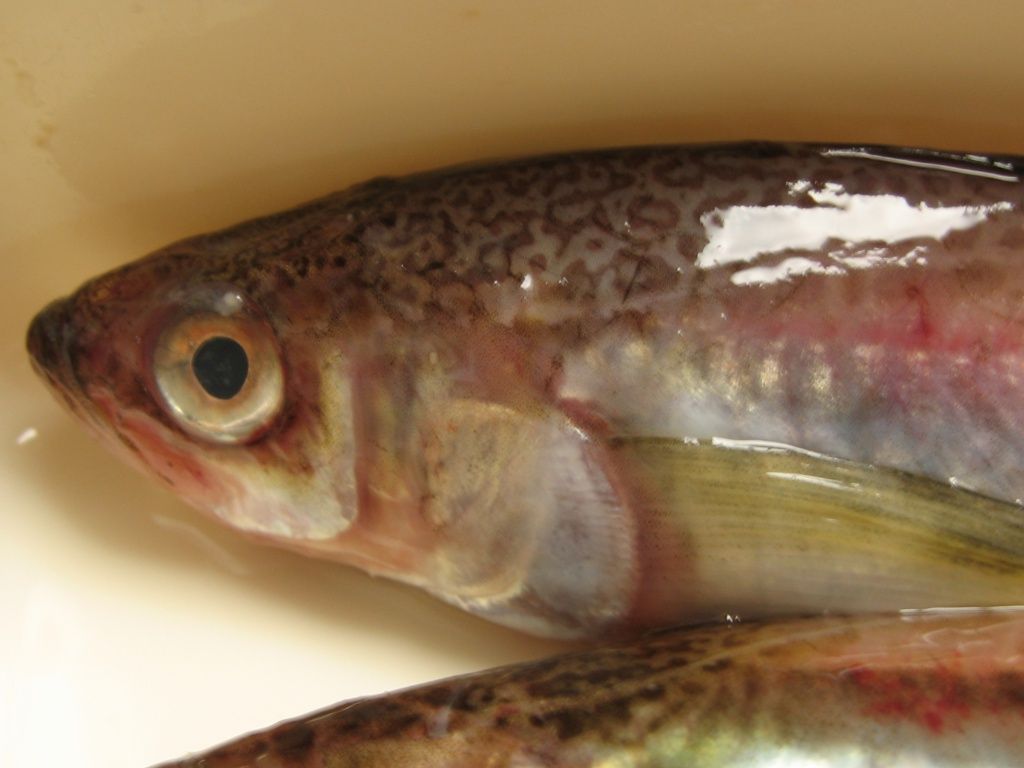 Photo: でんぜろ from Japan., CC BY 2.1 jp, via Wikimedia Commons
Origin & History
Dorumuk (Arctoscopus japonicus) is a slender, scaleless fish about 25 cm long, with a pale belly and a yellow-brown pattern on the back. The Encyclopedia of Korean Culture says it is most common from the middle of the East Sea coast northward. Outside spawning season it lives on sandy or muddy bottoms at roughly 100 to 400 m, and in early winter it moves into shallower, seaweed-rich water to lay its eggs. That is why it is a winter fish, and why its season is tied to the Gangwon coast (see Gangwon and Sokcho).
The name is the stuff of legend. The encyclopedia records a tale from the Joseon-era texts Gogeum seongnim and Songnam japji: a Goryeo king, fleeing east, ate a fish called mokeo, praised its flavor and renamed it eoeo, "silver fish". Back in his capital he found it disappointing and ordered the old name restored, so the fish became "dorumok", then dorumuk. Popular versions today more often attach the story to King Seonjo during the Imjin War, and the encyclopedia mentions yet another variant involving King Injo. The tale is folklore, not documented history, but it lives on in the saying malljjang dorumuk, for effort that comes to nothing.
Newspapers describe a fish that has had cheap and scarce decades. A 2013 Seoul Shinmun report said it was so abundant in the 1970s and 1980s that vendors sold it from carts by the shovelful, after which catches dropped as seawater warmed and seaweed beds declined. A 2014 news report adds that a catch-limit system was introduced in 2009. In season, from about November through December, it is grilled with salt, braised in a sweet-and-spicy sauce (jorim) or stewed, as in saengtae-jjigae, and the roe-filled females are the most sought after.
Nutrition
| Calories | 113 kcal |
|---|---|
| Protein | 16 g |
| Fat | 4.6 g |
| Carbohydrates | 0.5 g |
| Fiber | Not reported |
| Sodium | Not reported |
Notable forProtein · Phosphorus
Values from the Korean Food Composition Table, which also lists about 163 mg phosphorus and 18 mg calcium per 100 g. Fiber and sodium are not reported for this entry. The table's separate entry for salted, dried dorumuk will be much saltier. Actual values vary with ingredients, portion size and preparation.
Health Benefits
- Lean, protein-rich fish: The Korean Food Composition Table gives about 16 g of protein and 4.6 g of fat per 100 g raw, a moderate-calorie fish.
- Sauce adds sodium: A jorim or stew seasoned with soy sauce and chili adds salt on top of the fish. See sodium in Korean food.
- Cook it through: Some places serve raw roe or whole raw fish with the bones. Cooking thoroughly lowers the risk of foodborne illness, which matters especially for children, pregnant people and older adults. See food safety at home.
- Variable supply: Korean press reports describe wide swings in catches and management limits since 2009, so ask where a fish was landed and favor in-season, local fish.
Informational, not medical advice. Talk to a qualified professional about your own health and diet.
Dishes with Sailfin sandfish (dorumuk)
Dish guides featuring sailfin sandfish (dorumuk) are coming soon.