Ingredient
Sweet potato
고구마
Romanization: goguma
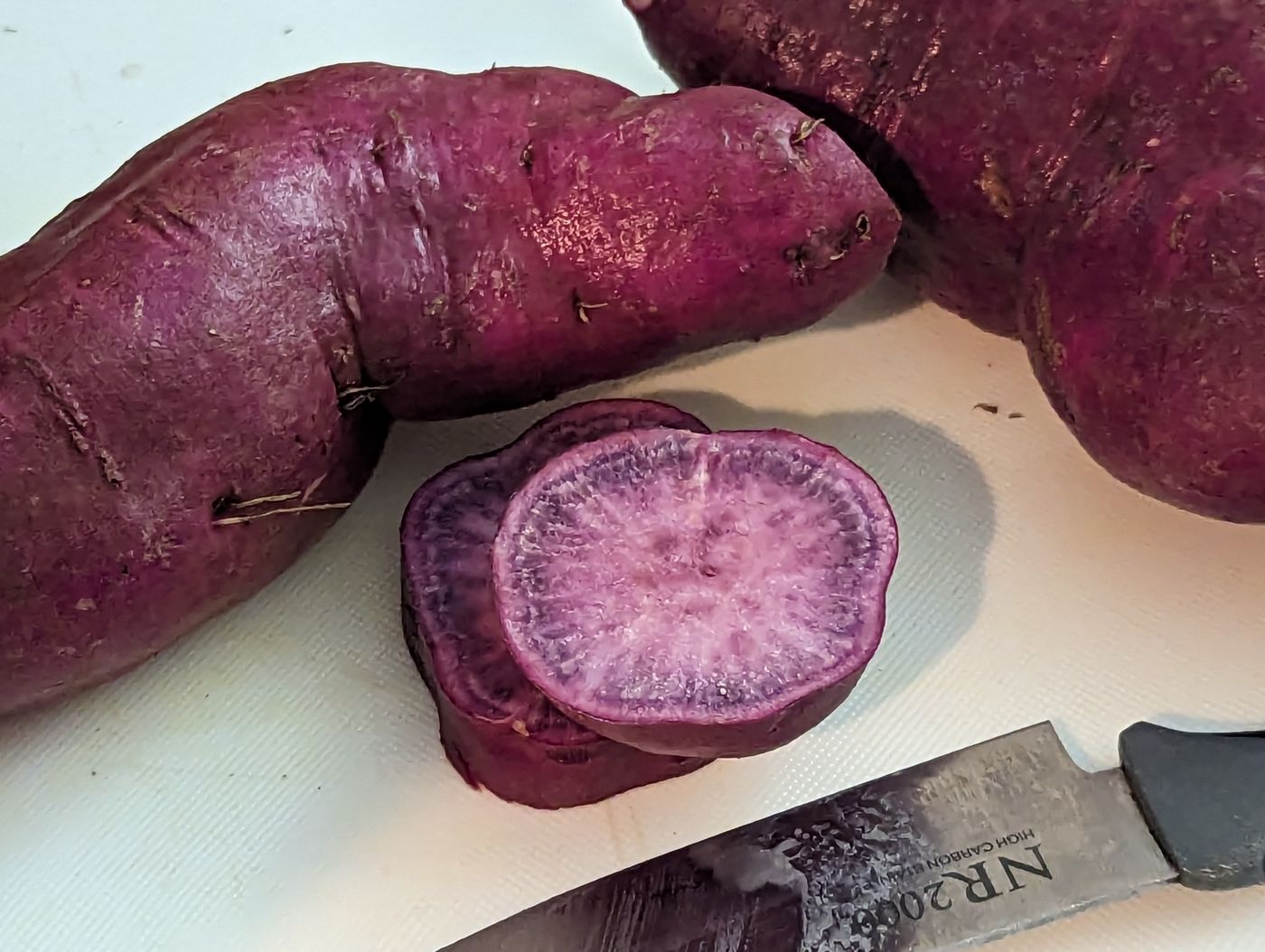
Red-skinned, pale- or golden-fleshed Korean sweet potatoes, steamed or roasted whole as a snack, braised and candied as banchan, and milled into the starch that becomes dangmyeon. The tender stems are blanched and stir-fried as goguma-julgi namul.
Flavor
Sweet, nutty and chestnut-like. Dry Korean types are fluffy and floury when steamed; moist types turn soft, sticky and honeyed when roasted, with caramelized edges.
Origin & History
The sweet potato (Ipomoea batatas), a vine of the morning glory family (Convolvulaceae), originated in tropical America and reached Korea by way of Japan. Its Korean name is usually traced to a Japanese name recorded by Korean envoys as gogwiwima. Koreans knew of the crop from the mid-seventeenth century through castaways and diplomatic missions who saw it eaten in Japan, but it was not grown in Korea until the later eighteenth century.
The usual account credits Jo Eom, chief envoy of the 1763 mission to Japan, who obtained sweet potatoes on Tsushima and sent them home to be trial-planted in Dongnae (near present-day Busan) and on Jeju, where the crop was long called jojeo, "Jo's tuber," after him. Others were working toward the same goal: the scholar Yi Gwang-ryeo, who had read about the plant as a famine crop in Chinese agricultural writing, tried repeatedly to obtain it, and the Dongnae magistrate Kang Pil-ri succeeded in growing it and wrote Kangssi gamjeobo, the first Korean treatise on the sweet potato. Through the late eighteenth and nineteenth centuries scholars including Pak Je-ga and Seo Yu-gu promoted it as a famine crop, and growers gradually extended it northward to Seoul. Cultivation became nationwide only in the twentieth century.
Sweet potatoes need heat and a long frost-free season, so they are grown mainly in the south. They are harvested from late summer to October, before the first frost, and keep best at around 12 to 13°C; in storage some starch converts to sugar and the roots grow noticeably sweeter. Korean varieties range from dry, chestnut-like types to moist, honey-sweet ones.
Sweet potatoes are steamed or roasted and eaten whole, fried as jeon and twigim, cooked into syrup and taffy (goguma-yeot, a Jeolla specialty), and glazed with syrup as goguma-mattang. Sweet potato starch is the traditional base for dangmyeon glass noodles, the heart of japchae, and the leaf stalks are peeled and cooked as namul.
Nutrition
| Calories | 147 kcal |
|---|---|
| Protein | 1.09 g |
| Fat | 0.15 g |
| Carbohydrates | 35.52 g |
| Fiber | 2.4 g |
| Sodium | 8 mg |
Notable forPotassium · Vitamin C · Folate · Manganese
Korean Food Composition Table entry "Sweet potato (Goguma), Raw" (고구마, 생것): 62.2 g water, 375 mg potassium, 10.81 mg vitamin C, 66 µg folate, 0.73 mg manganese and 39 µg RAE vitamin A per 100 g. Korean sweet potatoes are typically drier and paler than the orange-fleshed types common in the United States: USDA FoodData Central's "Sweet potato, raw, unprepared" (FDC ID 168482) lists 77.3 g water, 86 kcal and 709 µg RAE vitamin A per 100 g. Actual values vary with ingredients, portion size and preparation.
Health Benefits
- Starchy staple: Sweet potato is chiefly a source of carbohydrate and energy, which is why it served as a famine crop; it also provides fiber, potassium, vitamin C and manganese.
- Flesh color matters: Orange-fleshed sweet potatoes are rich in beta-carotene (vitamin A); the paler Korean types listed in the Korean Food Composition Table contain much less.
- Preparation: Steamed or roasted sweet potato is a simple whole food; syrup-glazed goguma-mattang and fried twigim add considerable sugar and fat.
- Low in sodium: The root itself is naturally very low in sodium.
Informational, not medical advice. Talk to a qualified professional about your own health and diet.