Ingredient
Meju (Fermented Soybean Blocks)
메주
Romanization: meju
Blocks of cooked, mashed soybeans dried and fermented by molds and bacteria over the winter. Steeped in brine, meju yields both ganjang and doenjang; ground, it goes into gochujang.
Flavor
Not usually eaten as is. Dried blocks smell strongly earthy, nutty and pungent, like aged cheese and hay. That funk mellows in brine into the deep, savory, slightly sweet character of homemade doenjang and ganjang.
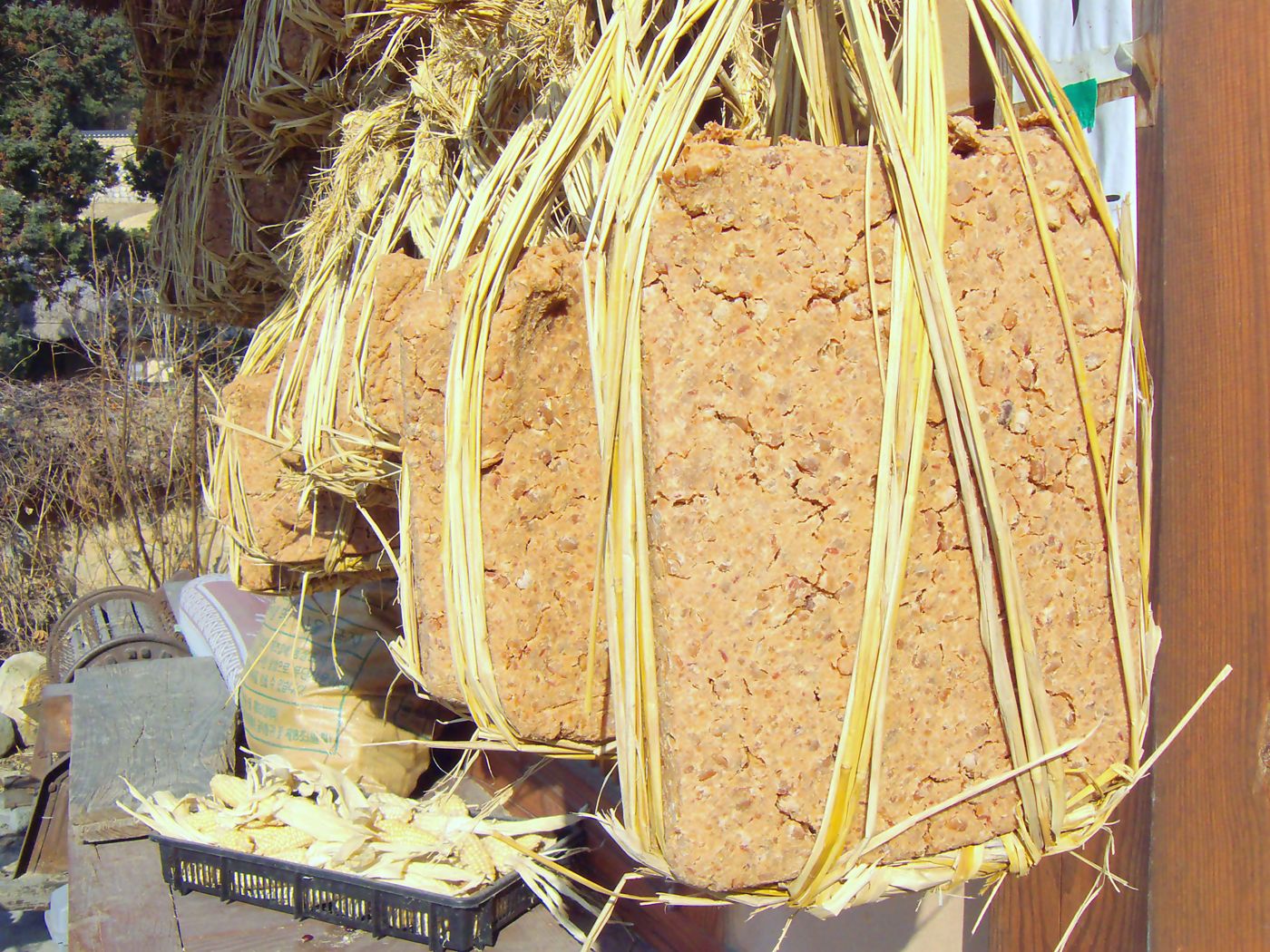 Photo: Kok Leng Yeo, CC BY 2.0, via Wikimedia Commons
Origin & History
Meju is the starting point of Korean jang. The Encyclopedia of Korean Culture traces the word to the 12th-century Gyerim yusa, a Song glossary of Goryeo speech, which records the local word for jang as something like ‘miljeo,’ read as an early form of meju; at the time the word seems to have covered both the blocks and the sauces. The encyclopedia also points to the fermented beans (si) listed as a Balhae specialty and to Samguk sagi references to soy sauces, concluding that meju has a very long history on the peninsula.
The traditional method is simple and slow. Soybeans are boiled soft, pounded and shaped into blocks, dried on rice straw for a few days, then tied with straw and hung in a warm room or packed with straw in a box to ferment, before being sun-dried and fermented further. The 19th-century farm-calendar song Nonggawolryeongga, quoted in the encyclopedia, reminds households to make meju in the eleventh lunar month and to make jang in the third. Bacteria from the straw and airborne molds do the work; a recent study of meju fermentation found Bacillus and lactic acid bacteria among the bacteria and Aspergillus, Monascus and Scopulariopsis dominating the fungi by the end.
For jang, the blocks are washed and steeped in brine. The Encyclopedia of Korean Culture explains that a little brine gives rich doenjang while more brine lets cooks ladle off more ganjang. Since the 1960s, ‘improved’ meju made with wheat flour and a selected mold has been produced for factory jang; it ferments more evenly but, the encyclopedia notes, tastes simpler than wild-fermented meju. Korea's jang-making traditions were inscribed on UNESCO's intangible heritage list in 2024. See making jang.
Health Benefits
- Foundation of fermented soybean foods: Meju turns soybean protein into the peptides and amino acids behind jang's savory taste. Its nutritional value reaches the table through doenjang, ganjang and gochujang rather than meju itself.
- Mold toxins: Traditional open-air fermentation can also suit aflatoxin-producing molds. Korea's Ministry of Food and Drug Safety (MFDS) notes that aflatoxin is classified as a human carcinogen and is not easily destroyed by cooking. In a 2020 MFDS survey of 517 commercial Korean-style doenjang and meju products, all meju samples met the standard (15 µg/kg total aflatoxins) while 33 doenjang products exceeded it.
- Making it at home: MFDS guidance advises shaping blocks of about 1–2 kg, fermenting them at or below 30°C and 60 percent humidity in a clean space, removing surface mold and debris, drying them in sun and air, and washing them well before brining. It also advises aging doenjang at least six months.
- Allergens: Meju is made from soybeans, a major allergen; improved meju may also contain wheat.
Informational, not medical advice. Talk to a qualified professional about your own health and diet.
Dishes with Meju (Fermented Soybean Blocks)
Dish guides featuring meju (fermented soybean blocks) are coming soon.
Sources
- 01메주 (Meju) — Encyclopedia of Korean Culture
- 02장 (Jang) — Encyclopedia of Korean Culture
- 03된장 (Doenjang) — Encyclopedia of Korean Culture
- 04Knowledge, beliefs and practices related to jang-making in the Republic of Korea — UNESCO Intangible Cultural Heritage
- 05곰팡이 독소 걱정 없는 집된장 만드는 법 (Making home doenjang without mold toxins) — Ministry of Food and Drug Safety, via Korea.kr (2021)
- 06한식된장 33개 제품 아플라톡신 기준 초과 (33 doenjang products exceed aflatoxin standard) — Food Journal (2020)