Ingredient
Gugija (goji berry)
구기자
Romanization: gugija
Small, glossy red berries of the Chinese boxthorn, usually dried. Koreans simmer them into tea, steep them in liquor and add them to tonic soups; Cheongyang and Jindo are the best-known growing areas.
Flavor
Dried berries are chewy, mildly sweet and slightly tangy, with a faint bitter, herbal finish. Brewed as tea they give a soft, raisin-like sweetness and an amber color.
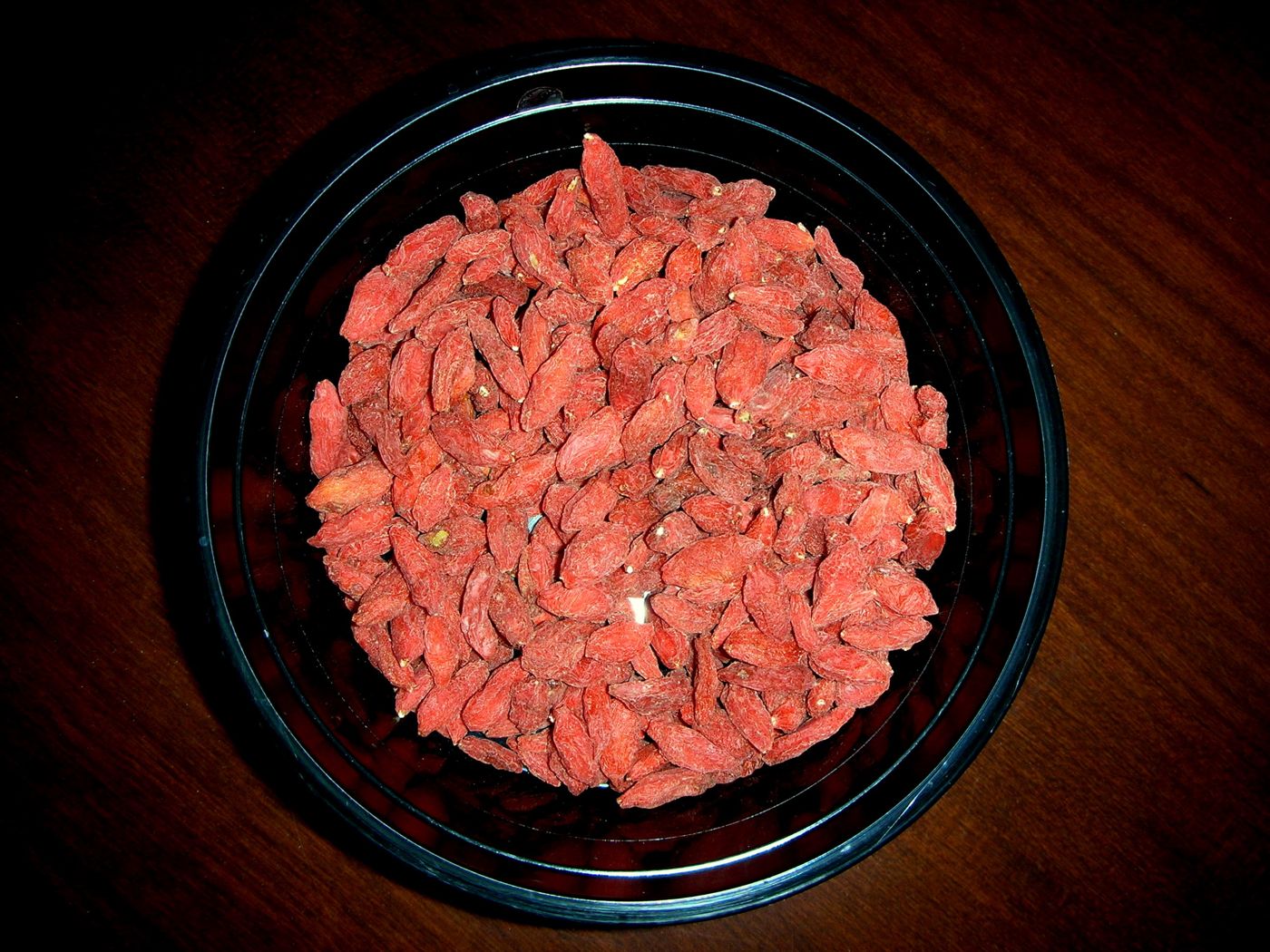 Photo: Maukie, Public domain, via Wikimedia Commons
Origin & History
Gugija is the fruit of the Chinese boxthorn or matrimony vine (Lycium chinense), a thorny deciduous shrub of the nightshade family about 1 to 1.5 meters tall. The Encyclopedia of Korean Culture describes purple flowers from June to September and oval red berries about a centimeter long that ripen in late summer and autumn, sweet at first with a bitter finish. Dried, they wrinkle and are packed with small seeds. In Korean herbal tradition the dried fruit is gugija, the leaves gugiyeop and the root bark jigolpi.
Gugija has long been a tonic food. The encyclopedia notes its use in Korean medicine as a strengthening herb and, in folk practice, as gugi-cha tea and gugi-ju liquor. Cheongyang in Chungcheongnam-do is the traditional collecting center for the crop, and Cheongyang gugija-ju, a rice wine brewed with the fruit, leaves and root bark in the Hadong Jeong head family for about 150 years, was designated a provincial intangible heritage in 2000. Recipes for goji liquor appear in Joseon texts such as Sallim gyeongje and Gyuhap chongseo. See traditional liquor.
On Jindo, off the southwest tip of the peninsula, goji is a signature crop. The Digital Jindo Culture Encyclopedia credits the island's long hours of sunshine for glossy, sweet, syrupy berries that herbal traders prize, reports about 60 tonnes harvested from 26 hectares in 2022, and notes that Jindo goji was registered as forest-product geographical indication No. 34 in 2007. Local producers turn it into goji doenjang, gochujang, liquor and tea.
At home, dried berries are most often simmered as tea. See traditional Korean teas.
Nutrition
| Calories | 69 kcal |
|---|---|
| Protein | 4.5 g |
| Fat | 2.04 g |
| Carbohydrates | 10.23 g |
| Fiber | 5.8 g |
| Sodium | 1 mg |
Notable forDietary fiber · Vitamin C · Potassium
Korean Food Composition Table entry "Goji berry, Fruit, Native, Raw" (구기자, 열매, 재래종, 생것), i.e. fresh rather than dried fruit: also 31.82 mg vitamin C, 601 mg potassium, 36 µg folate and 99 µg beta-carotene per 100 g. Dried goji is far more concentrated per 100 g, but a typical serving is only a small handful or a few grams in tea. Actual values vary with ingredients, portion size and preparation.
Health Benefits
- Fruit nutrients: Per the Korean Food Composition Table, fresh native goji fruit provides fiber, vitamin C and potassium.
- Tonic reputation: Korean herbal tradition treats gugija as a restorative for the liver, eyes and stamina. Those are traditional uses; claims about eye health or aging are not established for goji eaten as food.
- Warfarin interaction: Several case reports describe raised INR and bleeding in people on warfarin after drinking goji tea, juice or goji wine, including a 2001 report and a 2012 report of hospitalization. Most involved the closely related Lycium barbarum. If you take warfarin, talk to your doctor before using goji regularly, and MedlinePlus advises telling your clinician about all herbal products you take.
- Nightshade family: Goji belongs to the same family as tomatoes and peppers; people with known allergies to those plants may want to take care.
Informational, not medical advice. Talk to a qualified professional about your own health and diet.
Dishes with Gugija (goji berry)
Dish guides featuring gugija (goji berry) are coming soon.
Sources
- 01구기자나무 — Encyclopedia of Korean Culture
- 02청양 구기자주 — Encyclopedia of Korean Culture
- 03진도 구기자 — 디지털진도문화대전 (Academy of Korean Studies)
- 04Korean Food Composition Table: Goji berry, Fruit, Native, Raw — National Institute of Agricultural Sciences
- 05Possible interaction between warfarin and Lycium barbarum L. — Annals of Pharmacotherapy (2001)
- 06Probable interaction between Lycium barbarum (goji) and warfarin — Pharmacotherapy (2012)