Ingredient
Snow crab (daege)
대게
Romanization: daege
A long-legged cold-water crab of the deep East Sea, sweet and delicate, caught in winter and spring. Yeongdeok and Uljin both claim it as their own.
Flavor
Delicately sweet and clean, with long, juicy strands of white leg meat and a savory, creamy tomalley inside the shell.
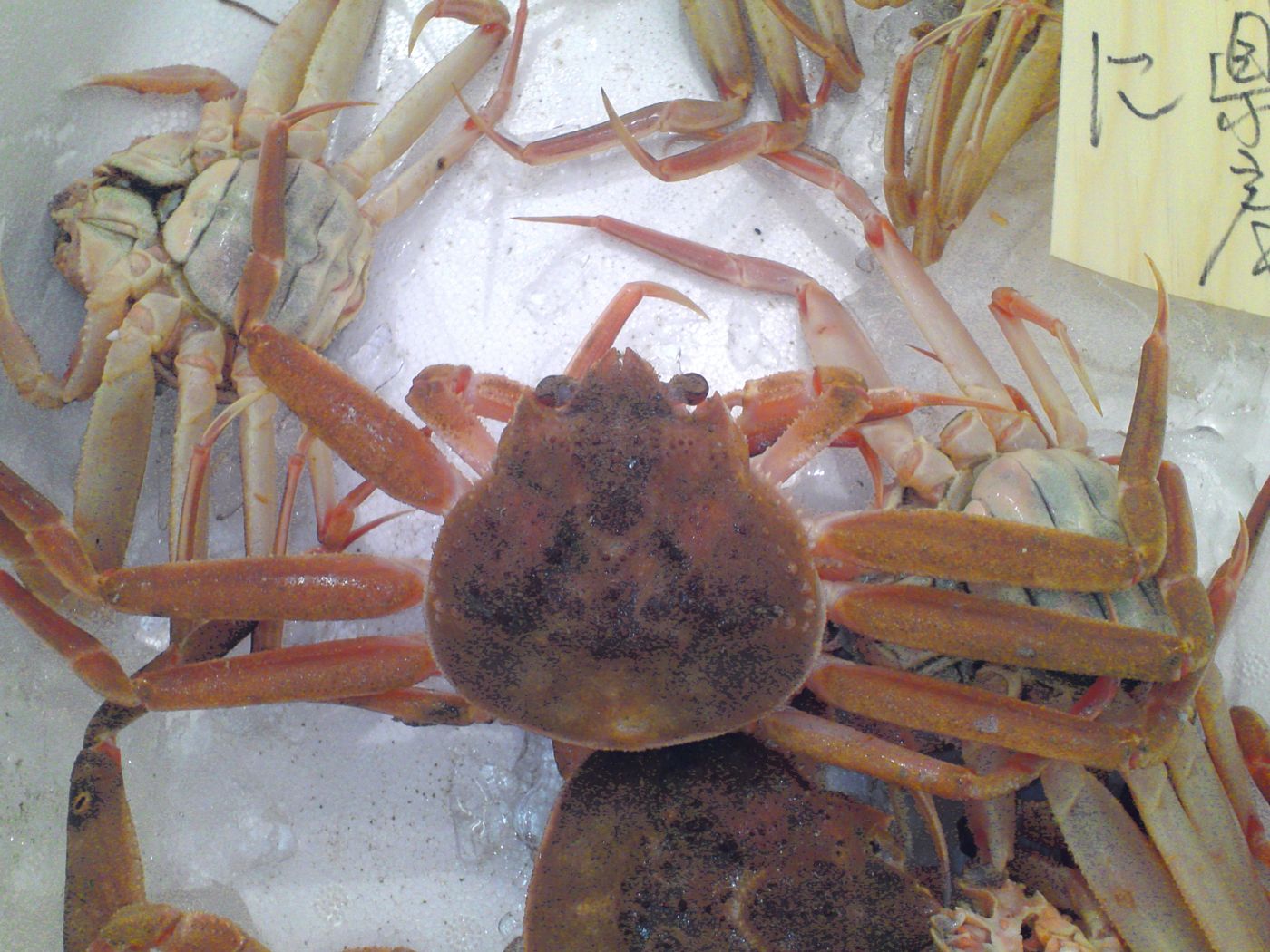 Photo: Togabi, CC BY-SA 4.0, via Wikimedia Commons
Origin & History
Daege does not mean "big crab," as many assume. According to the Encyclopedia of Korean Culture, the name comes from dae, bamboo: the long, jointed legs look like bamboo stems, and the crab's Chinese-character name is jukhae, "bamboo crab." It is a cold-water species that lives in the deep East Sea, roughly 150–250 m down where water stays just a few degrees above freezing; the Encyclopedia of Korean Folk Culture describes coastal gillnetters working depths of 130–450 m. Mating takes place in spring, and a female carries tens of thousands of eggs. A close relative, the red snow crab (bulgeun daege), is a separate species.
Daege is above all the crab of Yeongdeok, on the North Gyeongsang coast, where the main grounds lie offshore, and of neighboring Uljin, whose fishers work the rich Wangdolcho reef. The encyclopedia records that catches were enormous in the 1930s, still substantial in the 1950s, and fell from the 1960s as war damage to the fleet and shifting currents took their toll. To protect the stock, fishing runs only from about November or December to May, with a closed season in summer, and small crabs must be returned. Domestic crab therefore disappears from markets in summer and is replaced by imports. Most of the catch comes from gillnets, with some from traps, and it is sold largely within Korea to restaurants and individual buyers.
After local self-government arrived in the 1990s, the crab became a matter of civic pride. The folk encyclopedia describes a rivalry between Yeongdeok and Uljin over which is the "original" crab town, with each designating an ancestral crab village and launching festivals (Yeongdeok in 1998, Uljin in 2000); the market at Ganggu Port is a center of the crab trade. The crab is typically cooked whole, by boiling or steaming, and eaten leg by leg, after which rice is often stir-fried in the shell with the rich innards.
Nutrition
| Calories | 85 kcal |
|---|---|
| Protein | 17.4 g |
| Fat | 1 g |
| Carbohydrates | 0.5 g |
| Fiber | 0 g |
| Sodium | 475 mg |
Notable forCalcium (158 mg) · Phosphorus (114 mg)
Values copied from the Korean Food Composition Table (Rural Development Administration / National Institute of Crop Science) for this exact food, per 100 g edible portion. Blank fields in the table are shown as not reported. The table's English name "Tanner crab" corresponds to the Korean 대게. Boiled daege (게, 대게, 삶은것) lists 65 kcal, 15 g protein, 240 mg sodium, 3.1 mg zinc and 0.56 mg copper per 100 g. Red snow crab (붉은대게) is listed separately. Actual values vary with ingredients, portion size and preparation.
Health Benefits
- Lean protein: Raw snow crab provides about 17.4 g of protein and 1 g of fat per 100 g in the Korean table; the boiled entry lists 3.1 mg of zinc.
- Low mercury: The FDA/EPA advice on eating fish lists crab among its "Best Choices," the lowest-mercury group.
- Shellfish allergy: Crab is a crustacean shellfish, one of the nine major food allergens under U.S. law.
- Naturally salty: Crab meat carries sodium from seawater (475 mg per 100 g raw in the Korean table), and dipping sauces add more.
Informational, not medical advice. Talk to a qualified professional about your own health and diet.
Dishes with Snow crab (daege)
Dish guides featuring snow crab (daege) are coming soon.
Sources
- 01영덕대게 (Yeongdeok snow crab) — Encyclopedia of Korean Culture
- 02대게잡이 (Snow crab fishing) — Encyclopedia of Korean Folk Culture, National Folk Museum of Korea
- 03영덕군 (Yeongdeok County) — Encyclopedia of Korean Culture
- 04Korean Food Composition Table — Tanner crab (대게), Raw
- 05Advice about Eating Fish — U.S. Food and Drug Administration / EPA
- 06Food Allergies — U.S. Food and Drug Administration