Ingredient
Chonggak radish (ponytail radish)
총각무
Romanization: chonggangmu
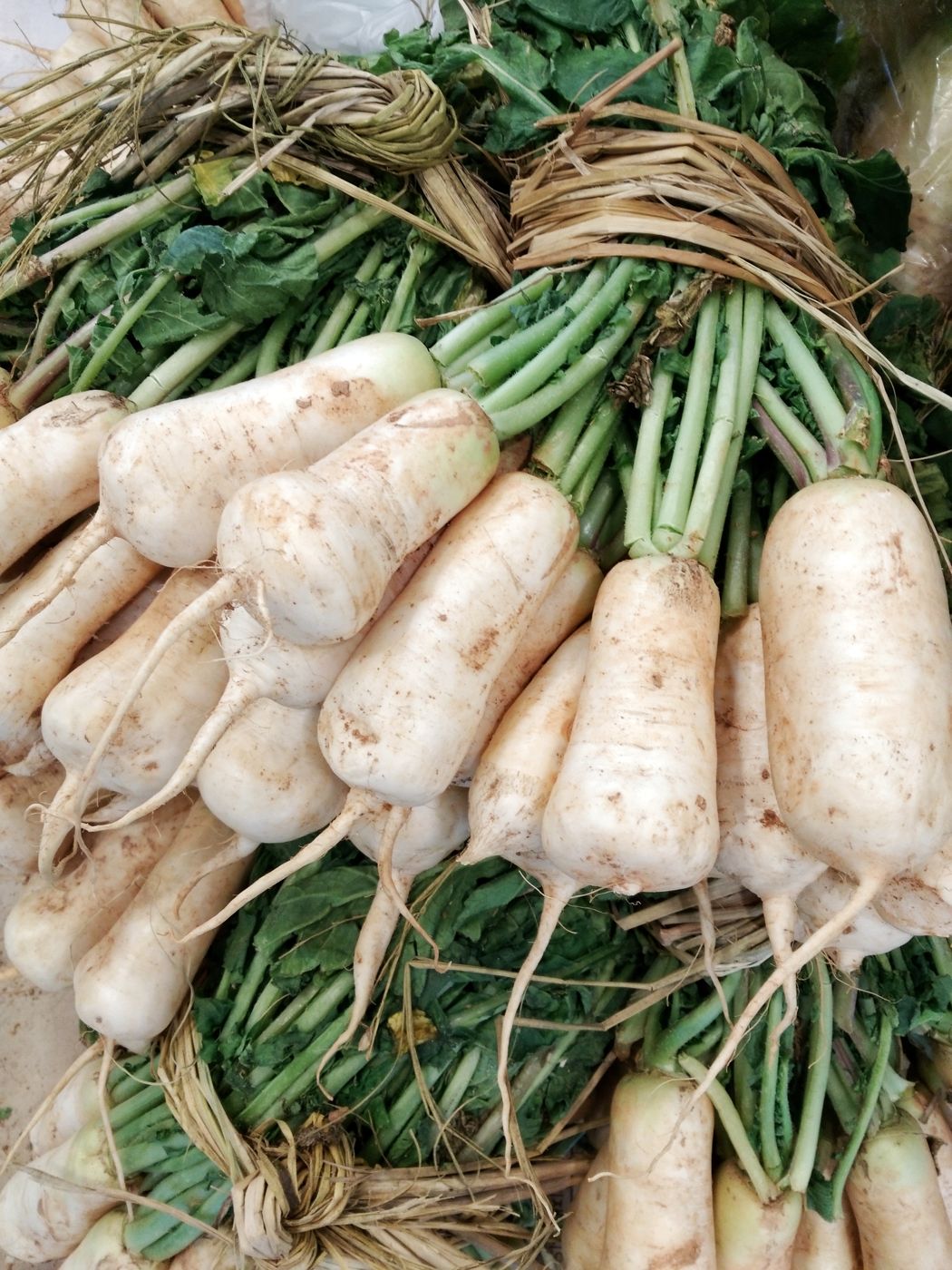
Small, plump, finger-length radishes sold with their long green tops still attached. Pickled whole, roots and leaves together, as crunchy chonggak-kimchi.
Flavor
Crisp, dense and juicy, with a sharper radish bite than large Korean radish and slightly bitter, chewy greens. Fermented, it becomes tangy, spicy and satisfyingly crunchy.
Origin & History
Chonggak radish is a small, very early-maturing type of radish (Raphanus sativus), also widely sold under the name altari-mu; chonggangmu is the standard Korean term. The name comes from chonggak, the old hairstyle in which an unmarried young man's hair was gathered and tied up: the round, blunt root with its tuft of leaves was thought to resemble it. In English it is sometimes called ponytail radish.
Modern chonggak radish was bred from Seoul spring radish, a long-grown local variety, and its cultivation spread nationwide from the mid-1970s, expanding further once varieties suited to both spring and autumn sowing were introduced. Its roots are starchy but do not store well. The kimchi made from it seems to have taken the name chonggak-kimchi around the 1950s: a women's magazine in 1959 described it as a homely, charming kimchi to munch from the hand in midwinter, and a 1961 newspaper kimjang column recommended the radish for dongchimi.
The crop is fast, ready in about 40 to 50 days, when the roots are roughly 9 to 12 centimeters long and weigh around 100 grams. It is grown in greenhouses, under tunnels and in open fields, mostly in the southern provinces and in farm belts around large cities. Long exposure to cold can make it bolt before the root fills out.
Nearly the entire harvest goes into kimchi. For chonggak-kimchi, the radishes are salted whole with their greens, then tossed with chili powder, scallion, garlic, ginger, salted shrimp and glutinous-rice paste and packed tightly to ferment. It can also be made as a mild water kimchi, chonggak-dongchimi. Chonggak kimchi still ranks among the kimchi Korean households like best.
Nutrition
| Calories | 23 kcal |
|---|---|
| Protein | 1.38 g |
| Fat | 0.11 g |
| Carbohydrates | 5.14 g |
| Fiber | 2.7 g |
| Sodium | 29 mg |
Notable forVitamin K · Vitamin C · Calcium · Folate
Korean Food Composition Table entry "Radish, Small, Raw" (총각무, 전체, 생것): also 90.1 µg vitamin K, 15.6 mg vitamin C, 82 mg calcium and 60 µg folate per 100 g. Actual values vary with ingredients, portion size and preparation.
Health Benefits
- Root and greens together: Eaten whole, chonggak radish combines a low-calorie root with leafy tops that add vitamin K, calcium and folate (Korean Food Composition Table).
- Vitamin C: It provides a modest amount of vitamin C.
- Fermented form: As kimchi it is a fermented food; research on the possible health effects of fermented vegetables is ongoing.
- Sodium caveat: Chonggak kimchi is heavily seasoned and salted, so its sodium content is far higher than that of the fresh radish.
Informational, not medical advice. Talk to a qualified professional about your own health and diet.