Ingredient
Chamnamul (Korean wild parsley)
참나물
Romanization: chamnamul
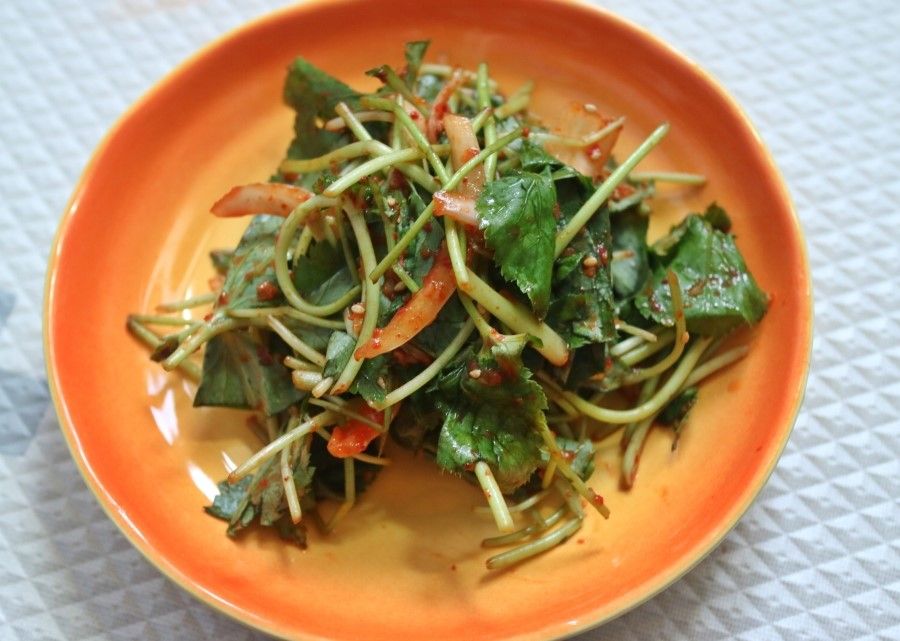
A cool-loving mountain herb of the carrot family, sold in fragrant bunches of three-part leaves on slender stems. Its celery-and-parsley perfume shines in quick raw chamnamul-muchim and lightly blanched namul.
Flavor
Fresh, green and aromatic, like a mix of celery leaf and flat-leaf parsley with a faint sweetness. The stems are crisp and juicy; the leaves tender.
Origin & History
Chamnamul (Pimpinella brachycarpa) is a perennial of the carrot and parsley family (Apiaceae) that grows wild in the shade of forests on high mountain slopes, roughly 300 to 1,400 meters above sea level, across Korea, northeastern China and Japan. The plant is hairless and aromatic and grows up to about a meter tall. Its leaves divide into three pointed, toothed leaflets, the stalks wrap the stem at their base, and small white flowers open in compound umbels in early summer. The name means "true namul": the prefix cham- marks something as the genuine or best of its kind.
The young shoots have long been gathered in spring and eaten fresh or dressed, fried or put into kimchi. Korea's Rural Development Administration describes it as a premium mountain vegetable with a distinctive taste and aroma. Rising demand has turned it into a promising cash crop, grown under shade netting in cool highland fields and in winter greenhouses. Cultivated chamnamul is milder in scent than the wild plant. The main harvest runs from about April to June, when the shoots are tender, and greenhouse crops fill the winter months.
Shoppers often confuse it with the similar-looking padeudeuk-namul (Cryptotaenia japonica, Japanese honewort, also called bandi-namul or samyeopchae). The usual rule of thumb is that true chamnamul has purplish stems and padeudeuk-namul green ones.
Because its scent is delicate, chamnamul is handled lightly. It is tossed raw with vinegar, gochugaru and sesame as chamnamul-muchim, blanched for a few seconds and seasoned with salt or soy sauce and sesame oil as namul, fried as twigim, or added to kimchi.
Nutrition
| Calories | 20 kcal |
|---|---|
| Protein | 1.58 g |
| Fat | 0.19 g |
| Carbohydrates | 4.09 g |
| Fiber | 2.6 g |
| Sodium | 18 mg |
Notable forVitamin K · Vitamin A (as beta-carotene) · Potassium · Iron
Korean Food Composition Table entry "Chamnamul, Cultivated, Raw" (참나물, 재배, 생것): also 314.98 µg vitamin K, 1,626 µg beta-carotene (136 µg RAE vitamin A), 582 mg potassium and 1.38 mg iron per 100 g. The Table's separate wild-chamnamul entry lists higher energy and beta-carotene but leaves fiber, folate and vitamin K unreported. Actual values vary with ingredients, portion size and preparation.
Health Benefits
- Leafy green: Per the Korean Food Composition Table, cultivated chamnamul is very low in calories and a source of vitamin K, beta-carotene, potassium and fiber.
- Traditional beliefs: Korean farm references list many folk-medicine uses for chamnamul, from fever to blood pressure. These are traditional ideas, not established health effects of eating it.
- Wash well: Like other greens eaten raw, rinse chamnamul thoroughly under running water before dressing it.
- Vitamin K and warfarin: Chamnamul is high in vitamin K. People taking warfarin are advised to keep their intake of vitamin K–rich greens consistent from week to week and to talk with their doctor before changing their diet.
Informational, not medical advice. Talk to a qualified professional about your own health and diet.