Ingredient
Burdock root
우엉
Romanization: ueong
A long, slender, earthy root with brown skin and pale flesh. Julienned and braised in soy sauce and syrup, it becomes the sweet, chewy, glossy ueong-jorim.
Flavor
Earthy, nutty and faintly sweet, with a hint of bitterness and astringency that soaking removes. The flesh is fibrous and crunchy, becoming pleasantly chewy when braised.
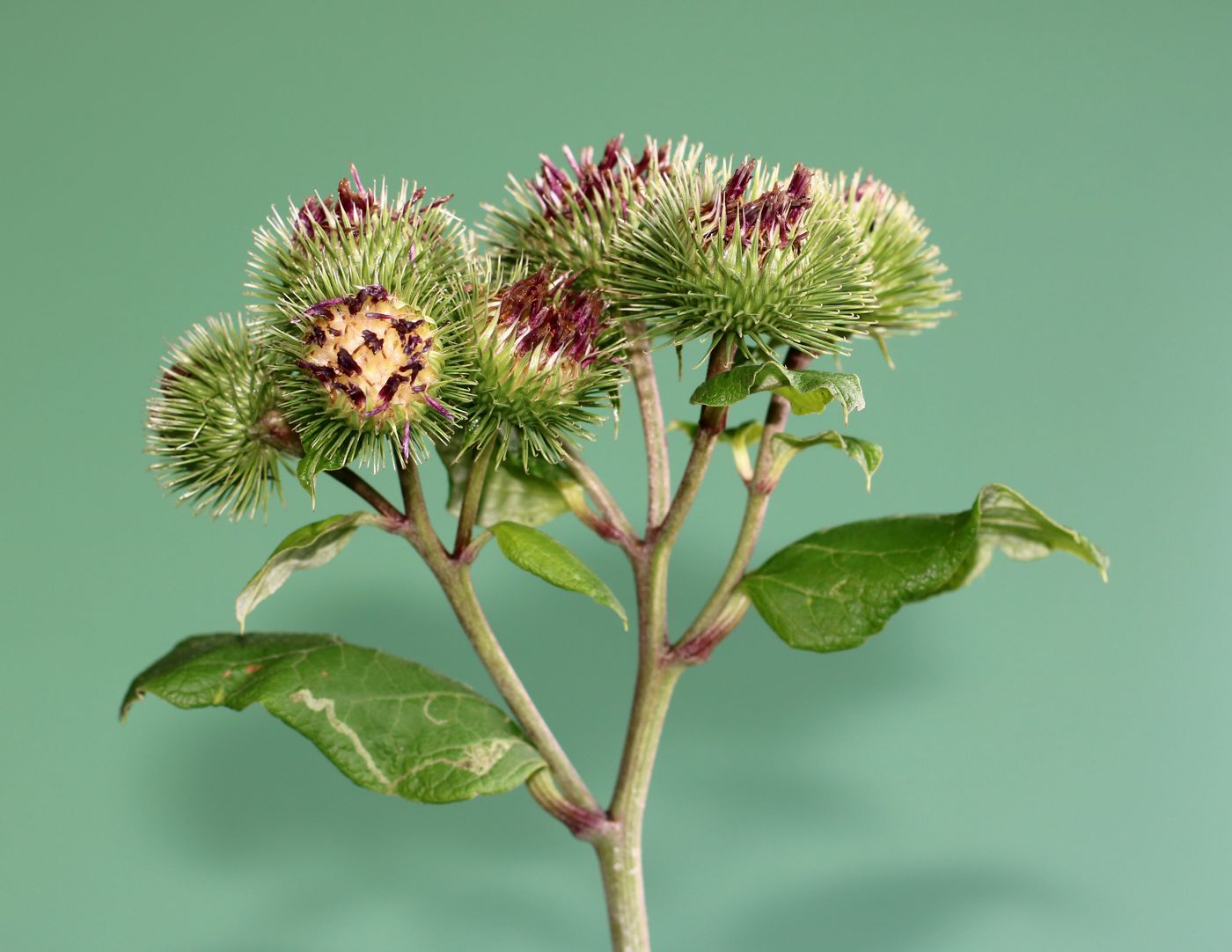 Photo: George Chernilevsky, CC BY 4.0, via Wikimedia Commons
Origin & History
Burdock (Arctium lappa) is a biennial of the daisy family (Asteraceae), thought to be native to Europe and long cultivated in China. The plant grows to about 1.5 meters, with broad, heart-shaped leaves that are whitish and downy underneath and purple thistle-like flowers in July; its taproot reaches 30 to 60 centimeters straight down. It is eaten as a vegetable in Korea, China and Japan.
In Joseon Korea burdock was valued as much as food in hard times as a garden vegetable. Imwon gyeongjeji, Seo Yu-gu's nineteenth-century encyclopedia of rural life, counts it among twelve famine plants: the leaves were boiled and soaked to remove bitterness and then seasoned with oil and salt, while the roots were boiled until tender. The same work describes ueong-po, flattened roots brushed with a paste of salt, soy sauce, fennel and ginger and grilled. Jeungbo sallim gyeongje recommends the leaves as namul, and in Korean herbal medicine the seeds, called aksil, are used as a remedy.
Burdock is grown across Korea but mainly in the south. It is sown in spring or autumn and needs deep, well-worked soil so the root grows long and straight without branching. Overall consumption is modest compared with staple vegetables.
The root is the part most often cooked. It is peeled, sliced thin or cut into fine matchsticks, soaked to draw out astringency, and then braised with soy sauce and grain syrup (jocheong) or plum syrup and finished with sesame oil and seeds, which is ueong-jorim. It is also pickled in doenjang as jangajji and stir-fried as namul. The leaves can be blanched for wraps or namul, and the stalks added to doenjang soups.
Nutrition
| Calories | 69 kcal |
|---|---|
| Protein | 2.61 g |
| Fat | 0.06 g |
| Carbohydrates | 15.29 g |
| Fiber | 4.6 g |
| Sodium | 6 mg |
Notable forDietary fiber · Potassium · Copper · Magnesium
Korean Food Composition Table entry "Burdock (Ueong), Raw" (우엉, 생것): also 406 mg potassium, 43 mg magnesium and 0.25 mg copper per 100 g. Actual values vary with ingredients, portion size and preparation.
Health Benefits
- Fiber: Raw burdock root provides 4.6 g of dietary fiber per 100 g (Korean Food Composition Table).
- Minerals: It is a source of potassium, magnesium and copper.
- Traditional use: Folk medicine in both East and West has credited burdock with aiding digestion; these are traditional beliefs rather than established health effects.
- Braised form: Ueong-jorim is cooked with soy sauce and syrup, which add sodium and sugar to an otherwise plain root vegetable.
Informational, not medical advice. Talk to a qualified professional about your own health and diet.