Ingredient
Coastal hog fennel (bangpung-namul)
방풍나물
Romanization: bangpung-namul
The young leaves and shoots of Peucedanum japonicum, a glossy seaside perennial of the carrot family. Cooks blanch them for namul, wrap rice in them, or stir them into porridge.
Flavor
Fragrant and herbal, somewhere between parsley and celery leaf, with a faint bitterness that mellows when blanched. It stands up to *doenjang*, *gochujang* and sesame dressings.
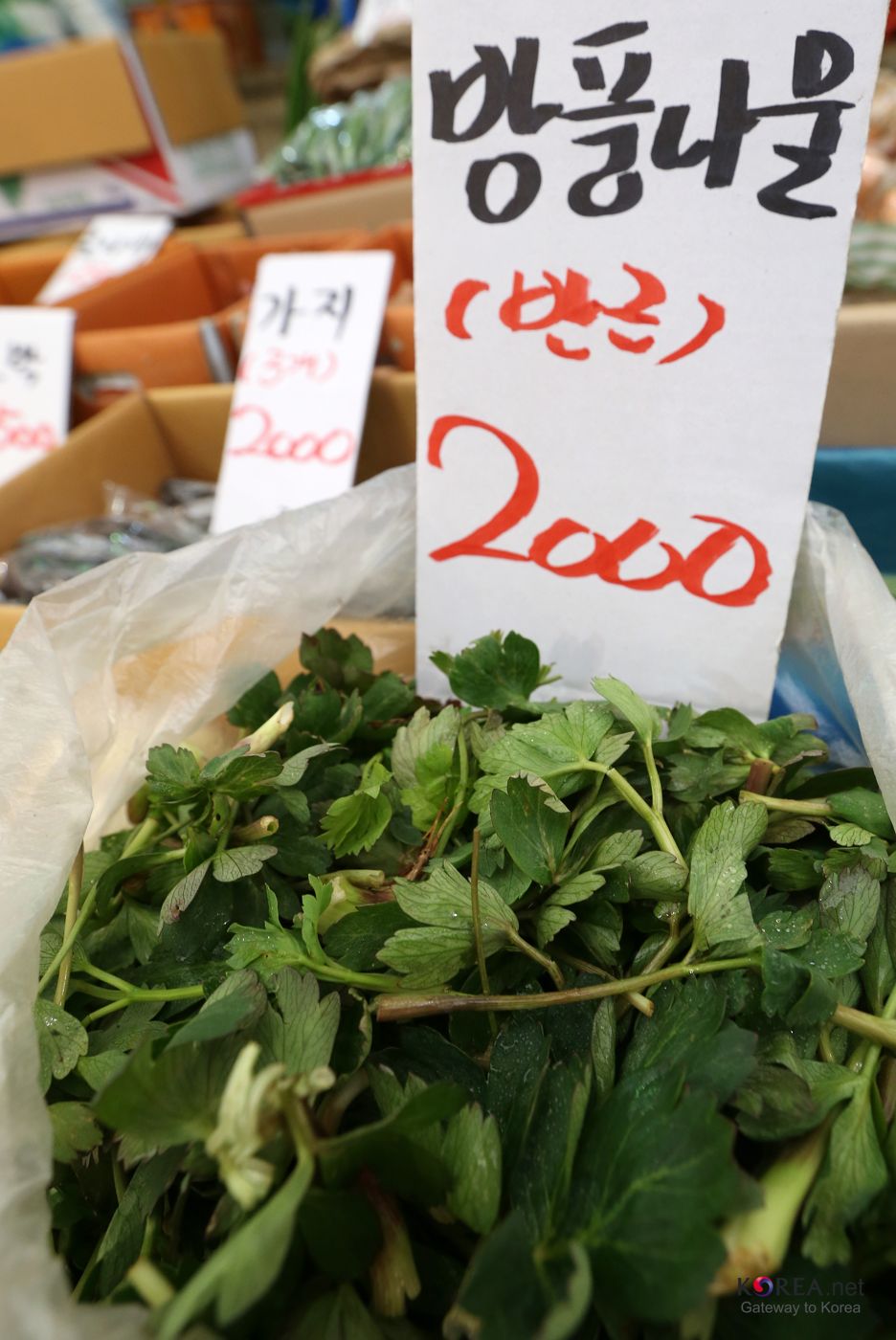 Photo: Korea.net / Korean Culture and Information Service (Jeon Han), CC BY-SA 2.0, via Wikimedia Commons
Origin & History
Despite the name, bangpung-namul is usually not the plant herbalists call bangpung. Korea's rural extension service explains that the green sold in spring is gaetgireum-namul (Peucedanum japonicum), whose dried root is the medicinal sikbangpung, and that the other two plants sharing the name are not native to Korea. The name gaetgireum points to the glossy leaves, which look as if brushed with oil, and to the shoreline where the plant grows wild. Today it is also cultivated as a leaf vegetable, and the Korean Food Composition Table lists open-field and greenhouse crops separately.
Its place at the table is older than the modern market. The Encyclopedia of Korean Culture describes bangpung-juk, a rice porridge flavored with bangpung leaves, with preparation instructions in the Joseon-era household manual Jeungbo sallim gyeongje. That text calls for young shoots gathered in early spring, ideally picked at dawn with the dew still on them, and the encyclopedia cites Domundaejak for the claim that the porridge's flavor lingers for days. Today, the extension service says the young shoots and tender leaves are briefly blanched and then seasoned or stir-fried, and that the leaves can also be eaten raw as wraps.
A recent paper on the plant's chemistry calls it a medicinal and dietary plant of Korea and Japan, known in Korean as sikbangpung and gaetgireum-namul. Folk texts link the root to "wind" ailments, which is a traditional idea rather than a medical finding. For cooks, bangpung is simply one of the aromatic spring greens, handled much like other wild namul (see blanching and seasoning namul and seasonal foods).
Nutrition
| Calories | 41 kcal |
|---|---|
| Protein | 3.94 g |
| Fat | 0.32 g |
| Carbohydrates | 7.91 g |
| Fiber | 5.1 g |
| Sodium | 3 mg |
Notable forCalcium · Vitamin K · Folate
Values from the Korean Food Composition Table, which also lists about 200 mg calcium, 431 µg vitamin K and 178 µg folate per 100 g raw. The greenhouse crop and the young-leaf entries are listed separately and differ somewhat. Actual values vary with ingredients, portion size and preparation.
Health Benefits
- Fiber and calcium: Raw open-field leaves provide about 5 g of fiber and 200 mg of calcium per 100 g in the Korean Food Composition Table, for 41 kcal.
- High in vitamin K: The table lists about 431 µg of vitamin K per 100 g raw. MedlinePlus advises people on warfarin to keep vitamin K foods steady from week to week. See vitamin K and leafy greens.
- Research is early: Laboratory and animal work on Peucedanum japonicum is active. One 2025 study fed mice a high-fat diet with or without a 1 percent root extract for 10 weeks, and the extract group gained less weight. A mouse study on a root extract does not show that eating the leaves does anything similar in people.
- Traditional medicine is not a recommendation: Texts that prescribe the root for wind-related ailments, headaches or joint pain reflect old belief. Do not treat a condition with the plant without a clinician's advice.
Informational, not medical advice. Talk to a qualified professional about your own health and diet.
Dishes with Coastal hog fennel (bangpung-namul)
Dish guides featuring coastal hog fennel (bangpung-namul) are coming soon.
Sources
- 01중풍을 막아주는 식물, 갯기름나물(식방풍) — Nongsaro, Rural Development Administration
- 02방풍죽 (Bangpung-juk) — Encyclopedia of Korean Culture
- 03Coastal hogfennel(Gaetgireumnamul), Leaf, Cultivated in open field, Raw — Korean Food Composition Table, National Institute of Agricultural Sciences
- 04Chlorogenic Acid from Peucedanum japonicum Attenuates TNF-α-Induced Oxidative Stress and Inflammatory Damage in Human Dermal Fibroblasts — Life (PMC)
- 05Anti-Obesity Effects of Peucedanum Japonicum Thunb Root Extract With Induction of Hepatic Cyp2b10 Gene Expression in Mice — J Food Sci (PMC)
- 06Taking warfarin (Coumadin) — MedlinePlus Medical Encyclopedia (NIH)