Ingredient
Japanese amberjack (bangeo)
방어
Romanization: bangeo
A big, fast jack whose winter fat makes it one of Korea's most anticipated sashimi fish. Moseulpo on Jeju's southwest tip celebrates it every November.
Flavor
Winter fish are rich, buttery and sweet, with pale pink flesh marbled with fat, especially in the belly; leaner summer fish are firmer and milder.
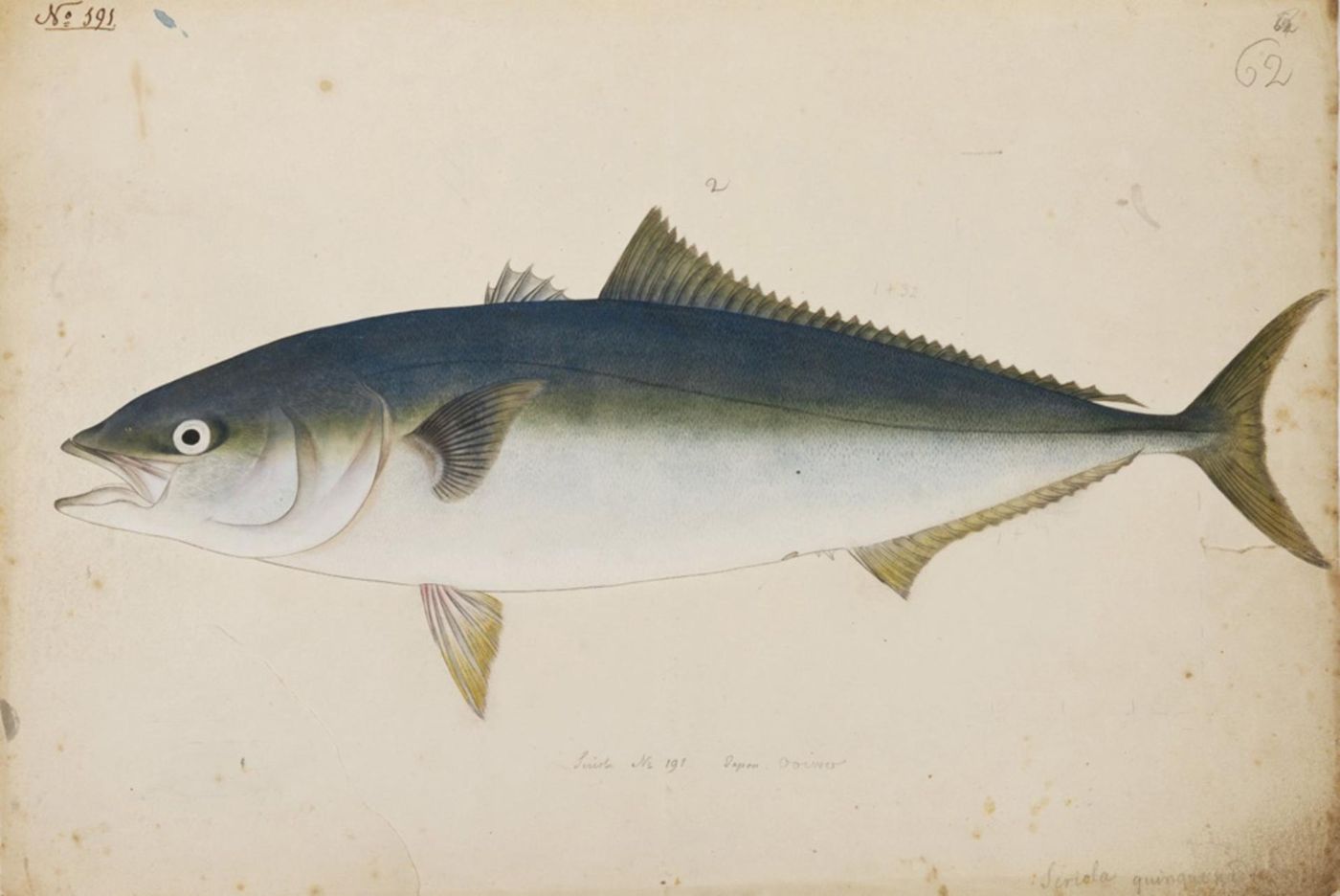 Photo: Temminck and Schlegel, Public domain, via Wikimedia Commons
Origin & History
Bangeo is the Japanese amberjack or yellowtail (buri in Japanese), a streamlined fish of the jack family that lives in the East Sea, the South Sea including Jeju, the southern Yellow Sea and the northwest Pacific. It migrates south in autumn and winter and north in spring and summer, and spawns roughly from February to June. Growth is fast: the Encyclopedia of Korean Folk Culture gives about 30 cm after one year, 50 cm after two and about a meter at six. Fishing communities name it by size; in Yeongdeok and elsewhere in North Gyeongsang a 10 cm fish is tteongmeremi, a 30 cm one meremi, and only fish over 60 cm earn the name bangeo. Market names split the adults by weight, from sobangeo under 2 kg to daebangeo over 4 kg, which commands sharply higher prices. It is easily confused with its larger cousin busiri (yellowtail amberjack); the angle of the upper jaw and the position of the fins tell them apart.
Bangeo is a winter fish. The folk encyclopedias explain that it puts on fat in the cold months, with a distinctive aroma and rich savory compounds, and that the bigger the fish, the thicker the fat; after spawning it becomes lean, and summer fish, which can carry parasites, are not eaten raw. A large daebangeo is prized because it can be eaten cut by cut, from the fatty belly to the meat near the fins and the tail. Beyond sashimi, it is salt-grilled, braised, and simmered into soup; Koreans sometimes also call it hiraseu, a Japanese dialect word.
On Jeju, bangeo is caught by handline and pole off the southwest coast. According to the Digital Seogwipo Culture encyclopedia, the fish come south in autumn to winter around Marado, feeding on the island's damselfish, and fishing grounds form there from October to February, landing at Moseulpo Port in Daejeong-eup. Since 2001 the port has hosted the Southernmost Bangeo Festival (Choenamdan Bangeo Chukje) every November, with bare-handed fish catching, net-pen fishing and tastings of the season's fish.
Nutrition
| Calories | 101 kcal |
|---|---|
| Protein | 21.7 g |
| Fat | 0.8 g |
| Carbohydrates | 0.4 g |
| Fiber | 0 g |
| Sodium | 32 mg |
Notable forNiacin (7.8 mg) · Phosphorus (289 mg) · Potassium (380 mg)
Values copied from the Korean Food Composition Table (Rural Development Administration / National Institute of Crop Science) for this exact food, per 100 g edible portion. Blank fields in the table are shown as not reported. The table's sample is very lean; fat rises sharply in large winter fish, as the folk encyclopedias describe, so winter bangeo will be considerably richer in fat and calories than these figures. The table also lists farmed and wild young fish separately. Actual values vary with ingredients, portion size and preparation.
Health Benefits
- Protein and niacin: Raw bangeo provides about 21.7 g of protein and 7.8 mg of niacin per 100 g in the Korean table; fatty winter fish also supply omega-3 fats typical of oily fish.
- Fish allergy: Fish is one of the nine major food allergens under U.S. law.
- Mercury: The FDA/EPA advice on eating fish does not rate amberjack or yellowtail, so it offers no specific mercury guidance for it.
- Raw fish and parasites: The folk encyclopedia notes that summer bangeo can carry parasites and is not eaten raw. The FDA recommends previously frozen fish for raw dishes and advises at-risk groups (pregnant women, young children, older adults, people with weakened immunity) to avoid raw fish.
Informational, not medical advice. Talk to a qualified professional about your own health and diet.
Dishes with Japanese amberjack (bangeo)
Dish guides featuring japanese amberjack (bangeo) are coming soon.
Sources
- 01방어 (Japanese amberjack) — Encyclopedia of Korean Folk Culture, National Folk Museum of Korea
- 02방어잡이 (Amberjack fishing) — Encyclopedia of Korean Folk Culture, National Folk Museum of Korea
- 03최남단방어축제 (Southernmost Bangeo Festival) — Digital Seogwipo Culture Encyclopedia, Academy of Korean Studies
- 04Korean Food Composition Table — Yellowtail, Raw
- 05Selecting and Serving Fresh and Frozen Seafood Safely — U.S. Food and Drug Administration
- 06Food Allergies — U.S. Food and Drug Administration