Ingredient
Monkfish (agwi)
아귀
Romanization: agwi
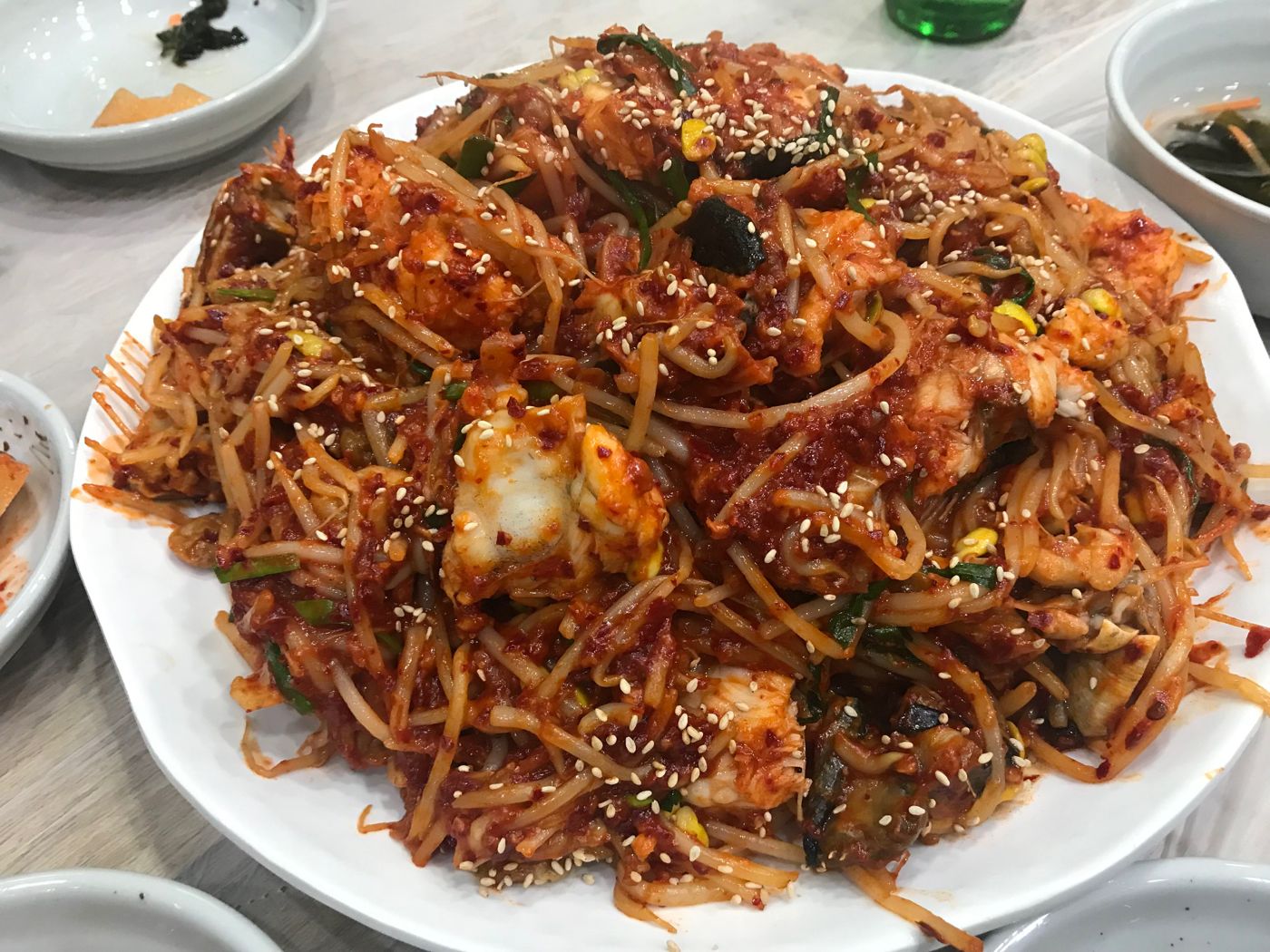
A wide-mouthed, scaleless anglerfish with firm, springy flesh and soft, gelatinous skin. It is the star of agu-jjim, the fiery braise with bean sprouts and minari from the port city of Masan.
Flavor
Mild and lightly sweet, with dense, springy, almost lobster-like flesh around a soft cartilaginous skeleton; the skin and fins turn gelatinous and chewy when braised.
Origin & History
Agwi is the blackmouth angler, Lophiomus setigerus, a flattened bottom fish with an enormous mouth, a lower jaw that juts past the upper, and soft skin covered in small fleshy flaps instead of scales. Like other anglerfish, it carries a long first dorsal spine that works like a fishing rod to lure prey. It lives on rocky or weedy sea floors off Korea's southwest coast and the southern East Sea, and spawns in spring. The Korean Food Composition Table also lists a related species, the yellow goosefish (hwang-agwi), and agwi liver.
The fish already appears in the early 19th-century natural history Jasan eobo, written by Jeong Yak-jeon in exile on Heuksan Island, as josaeo ("fishing-line fish"), with agueo ("hungry-mouth fish") as its common name. Jeong described the two rod-like spines on its head and the bait-like tip it twitches to draw fish into its jaws. Because valuable fish were sometimes found whole inside its stomach, a coastal proverb about eating agwi and flounder together means getting two benefits at once. The Encyclopedia of Korean Culture adds that the innards were thought even tastier than the flesh.
Agwi is best known through agu-jjim, which the Encyclopedia of Korean Culture describes as a local dish of Masan in South Gyeongsang. In the traditional version, dried agwi is cut into pieces, softened in water and simmered in strained doenjang broth; a heap of trimmed bean sprouts goes on top, followed by chili flakes, minari, green onion, garlic and a starch slurry, and the whole is turned and thickened into a hot, spicy braise with very little liquid. Fresh agwi is now common too, and the fish also goes into clear and spicy soups.
Nutrition
| Calories | 63 kcal |
|---|---|
| Protein | 14.1 g |
| Fat | 0.2 g |
| Carbohydrates | 0.5 g |
| Fiber | 0 g |
| Sodium | Not reported |
Notable forNiacin (4.2 mg) · Phosphorus (150 mg) · Iron (2.5 mg)
Values copied from the Korean Food Composition Table (Rural Development Administration / National Institute of Crop Science) for this exact food, per 100 g edible portion. The table does not report sodium for this entry. USDA FoodData Central's raw monkfish (a different anglerfish genus) lists 76 kcal, 14.5 g protein and 18 mg sodium per 100 g. Actual values vary with ingredients, portion size and preparation.
Health Benefits
- Very lean protein: Raw agwi has about 14 g of protein and well under 1 g of fat per 100 g, with niacin and phosphorus.
- Mercury: The FDA/EPA advice on eating fish lists monkfish as a "Good Choice," one serving a week during pregnancy and breastfeeding, rather than among the lowest-mercury "Best Choices."
- Fish allergy: Fish is one of the nine major food allergens under U.S. law.
- Cook it through: The FDA advises cooking fin fish to 145°F (63°C), or until the flesh is opaque and separates easily with a fork.
- The braise is salty and spicy: Agu-jjim is seasoned with doenjang, chili and soy, so portion the sauce with care if you are watching sodium.
Informational, not medical advice. Talk to a qualified professional about your own health and diet.
Sources
- 01아귀 (Blackmouth angler) — Encyclopedia of Korean Culture
- 02아귀찜 (Agu-jjim) — Encyclopedia of Korean Culture
- 03Korean Food Composition Table — Blackmouth angler, Raw
- 04Advice about Eating Fish — U.S. Food and Drug Administration / EPA
- 05Food Allergies — U.S. Food and Drug Administration
- 06Safe Food Handling — U.S. Food and Drug Administration