Ingredient
Sea squirt (meongge)
멍게
Romanization: meongge
A knobbly orange-red sea creature with a bracing, oceanic sweetness and a bitter-iodine finish. Most of Korea's supply is farmed around Tongyeong and Geoje, and it is eaten raw or tossed over rice in spring.
Flavor
Intensely briny, cool and sweet at first, then mineral and faintly bitter with a lingering iodine-like aftertaste; the flesh is soft, slippery and slightly crunchy.
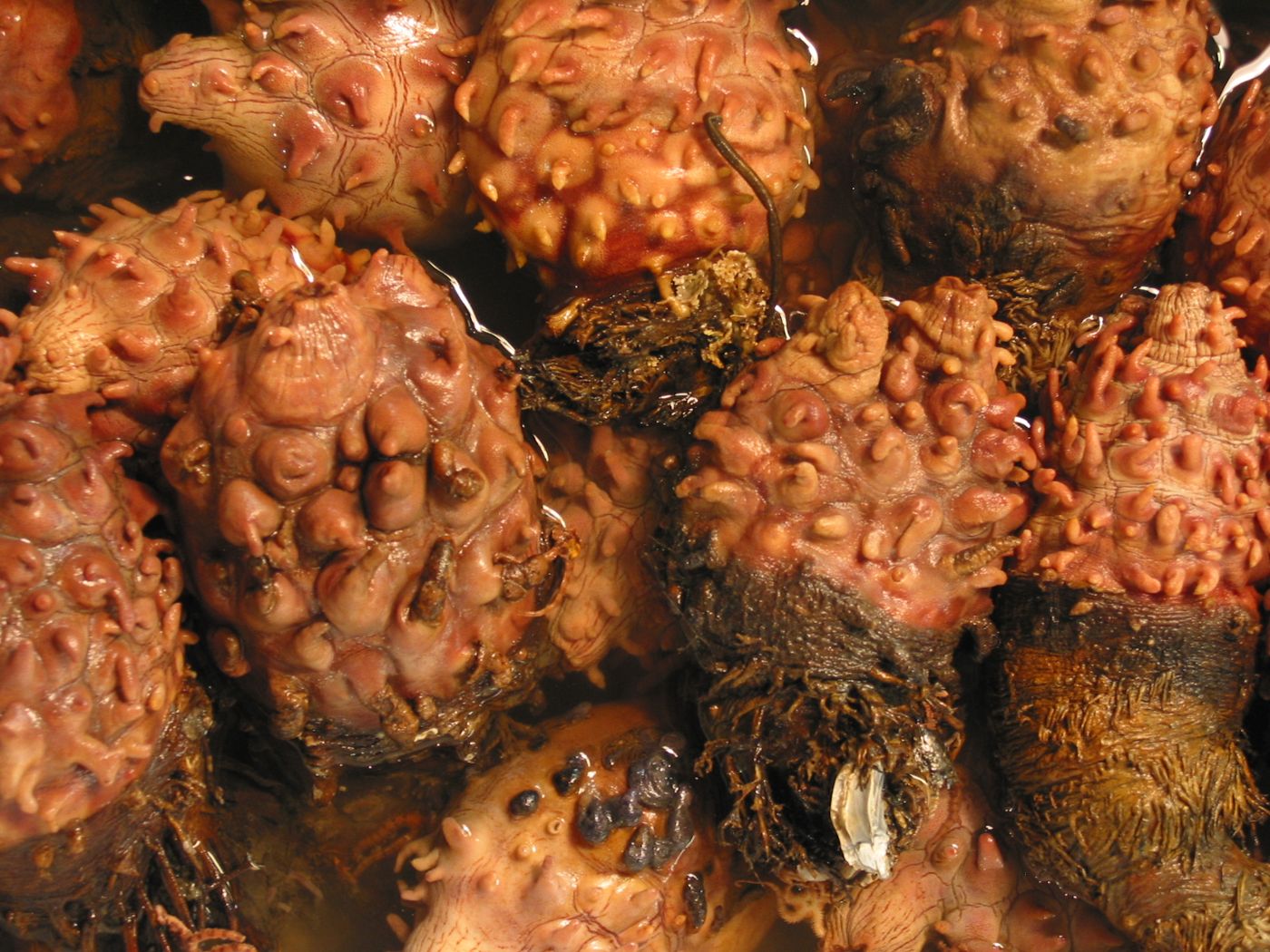 Photo: bifyu, CC BY-SA 2.0, via Wikimedia Commons
Origin & History
Meongge, also called ureongswengi (the official name in Korea's national species list), is the sea pineapple, a sea squirt. Despite looking like a mollusk, it belongs to the chordates: its free-swimming larva resembles a tiny tadpole with a notochord and nerve cord, which it loses after settling on rock to grow. The adult is an oval body in a tough, cellulose-containing tunic covered with thick knobs, anchored by root-like projections. It feeds by drawing seawater in through one siphon and filtering out plankton before expelling it through the other. The distinctive flavor comes from an unsaturated alcohol called cynthiol, and its muscle holds an unusually high amount of glycogen.
Sea squirt is eaten in Korea, Japan and China. According to the Encyclopedia of Korean Culture, Korea's first sea squirt farming began in the waters of Tongyeong in the 1970s, and farms now line the coasts of South and North Gyeongsang and Gangwon, shipping mainly from February to June. Tongyeong and Geoje together account for about 70 percent of national production. Wild sea squirts can be told apart by their larger, more numerous knobs and roots.
Because it cannot tolerate warm water, sea squirt is vulnerable to a changing sea. It dies above about 25°C, and a parasitic flagellate softens and kills it in cold months. During the prolonged marine heat wave of summer 2024, farmers in Tongyeong and Geoje reported losses of around 95 percent, and Korea's fisheries outlook center forecast reduced supply into 2026. At the table, meongge is split, cleaned and eaten raw with vinegared chili sauce, salted as meongge-jeot, or chopped over rice as meongge-bibimbap.
Nutrition
| Calories | 73 kcal |
|---|---|
| Protein | 8.7 g |
| Fat | 2.1 g |
| Carbohydrates | 4.9 g |
| Fiber | Not reported |
| Sodium | 1300 mg |
Notable forIron (6.9 mg) · Potassium (570 mg)
Values copied from the Korean Food Composition Table (Rural Development Administration / National Institute of Crop Science) for this exact food, per 100 g edible portion. Fiber is not reported. Wild sea squirt (멍게(우렁쉥이), 생것) in the same table is much lighter, at 27 kcal and 5 g protein per 100 g, with 5.3 mg zinc and the same 1,300 mg sodium. Actual values vary with ingredients, portion size and preparation.
Health Benefits
- Minerals: The Korean table lists notable iron and potassium in farmed sea squirt, and zinc in the wild form.
- Naturally very salty: Raw sea squirt carries about 1,300 mg of sodium per 100 g before any dipping sauce, and salted meongge-jeot adds more.
- Raw seafood: The FDA says cooking seafood is the safest choice and advises pregnant women, children, older adults and people with weakened immunity to avoid raw or undercooked seafood; sea squirt is almost always eaten raw.
- Allergies: Sea squirt is neither a fish nor a crustacean, so it is not among the nine major U.S. food allergens; people with seafood allergies should still check with an allergist before trying it.
Informational, not medical advice. Talk to a qualified professional about your own health and diet.
Dishes with Sea squirt (meongge)
Dish guides featuring sea squirt (meongge) are coming soon.
Sources
- 01멍게 (Sea squirt) — Encyclopedia of Korean Culture
- 02통영시 (Tongyeong) — Encyclopedia of Korean Culture
- 03"바다가 멍게 삶아" 고수온에 통영·거제 멍게 95% 폐사 — Gyeongnam Domin Ilbo (2024)
- 04Korean Food Composition Table — Common sea squirt, Farm-raised, Raw
- 05Selecting and Serving Fresh and Frozen Seafood Safely — U.S. Food and Drug Administration
- 06Food Allergies — U.S. Food and Drug Administration