Ingredient
Webfoot octopus (jjukkumi)
주꾸미
Romanization: jjukkumi
A small, short-armed octopus of the west and south coasts, best known in spring, when females are full of rice-like eggs. It is stir-fried with chili, blanched for dipping, or simmered in hot pots.
Flavor
Mild, sweet and lightly briny, more tender than nakji; spring heads full of eggs have a soft, starchy chew compared to sticky rice.
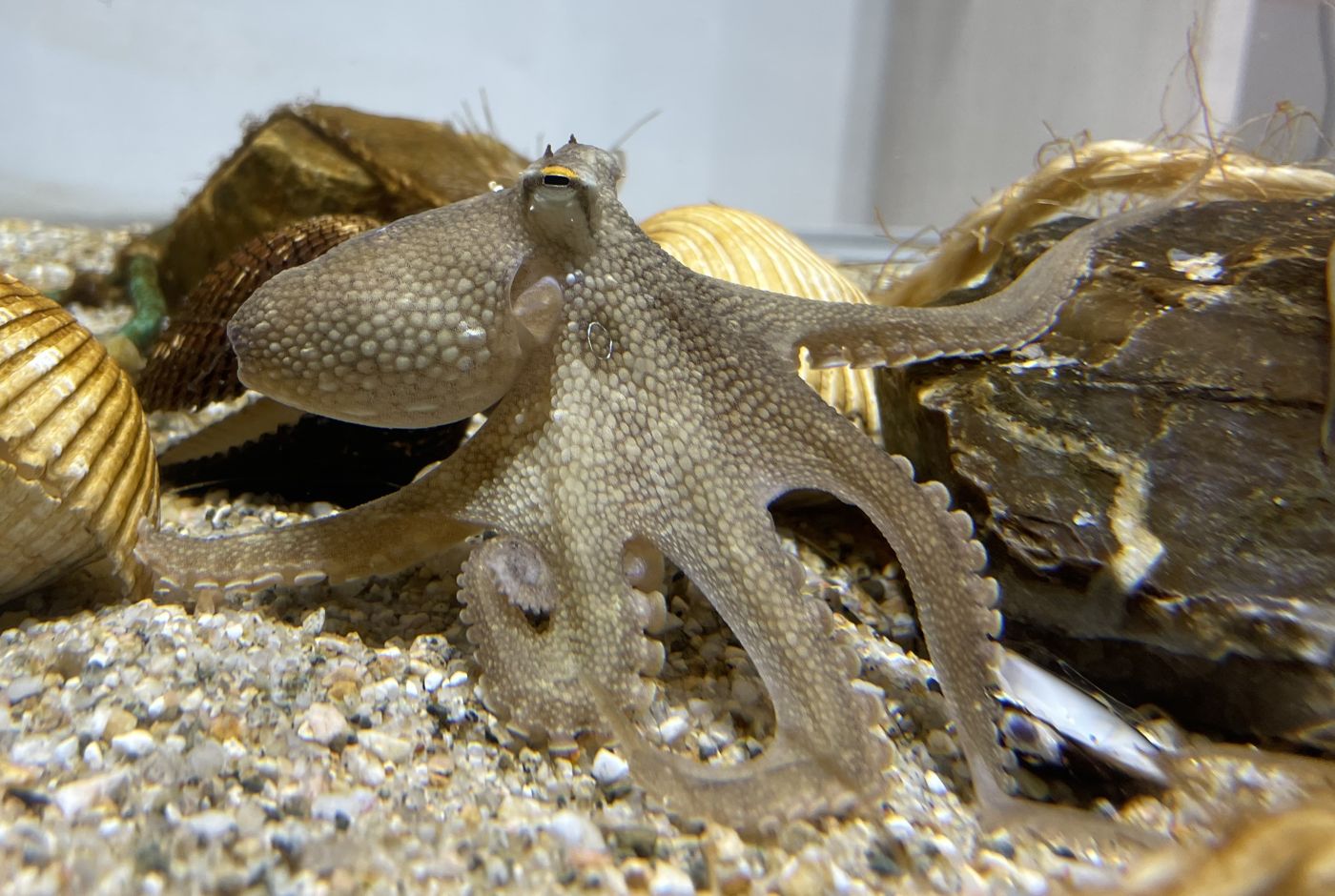 Photo: Totti, CC BY-SA 4.0, via Wikimedia Commons
Origin & History
Jjukkumi is Amphioctopus fangsiao, a small octopus reaching about 30 cm at most, smaller and shorter-armed than the long-arm nakji. It is usually grayish purple and carries a golden, eye-shaped spot on each side near the base of its arms. It hides by day in rock crevices and empty shells in shallow water off Korea, Japan and China. Fishers exploit that habit: the Encyclopedia of Korean Culture describes traps made from the shells of large whelks, lowered to the sea floor so the octopus crawls inside.
Joseon naturalists noticed the same features cooks still prize. Jeong Yak-jeon's Jasan eobo recorded it as a smaller cousin of the octopus with short arms, and Seo Yu-gu's Nanho eomokji observed that jjukkumi caught in early spring and boiled have heads packed with white grains like cooked rice, while after the third lunar month they turn lean and lose them. The Encyclopedia of Korean Folk Culture notes that in the southern Yellow Sea fishing starts around September, while in the central Yellow Sea it runs from late February to late May, and that some cooks consider autumn jjukkumi tastier even though spring animals are bigger. Spawning timing differs between the two encyclopedias (spring in one, autumn to early spring in the other).
The folk encyclopedia also points out that jjukkumi became a nationwide food only recently: in the 1970s and 1980s it was a cheap coastal staple, and better fishing and distribution later carried it inland. Today it is eaten blanched with vinegared chili paste, tossed as muchim, braised, and above all stir-fried with gochujang and gochugaru, often together with pork. Coastal towns hold spring festivals for it, including Seocheon's Camellia and Webfoot Octopus Festival at Maryangjin Port, timed for the March–April camellia bloom.
Nutrition
| Calories | 52 kcal |
|---|---|
| Protein | 10.8 g |
| Fat | 0.5 g |
| Carbohydrates | 0.5 g |
| Fiber | 0 g |
| Sodium | Not reported |
Notable forPhosphorus (129 mg) · Iron (1.4 mg) · Riboflavin (0.18 mg)
Values copied from the Korean Food Composition Table (Rural Development Administration / National Institute of Crop Science) for this exact food, per 100 g edible portion. Blank fields in the table are shown as not reported. Actual values vary with ingredients, portion size and preparation.
Health Benefits
- Very lean: Raw jjukkumi has about 52 kcal, 10.8 g of protein and half a gram of fat per 100 g in the Korean table.
- Watch the sauce: Its most popular form, jjukkumi-bokkeum, is cooked in gochujang and soy-based sauces that supply most of the dish's sodium and sugar.
- Mollusk allergy: Octopus is a mollusk, which is not among the U.S. major food allergens; people with shellfish allergies should ask an allergist which kinds to avoid.
- Lightly cooked seafood: The FDA says thorough cooking is safest and advises at-risk groups (pregnant women, young children, older adults, people with weakened immunity) to avoid raw or undercooked seafood.
Informational, not medical advice. Talk to a qualified professional about your own health and diet.
Dishes with Webfoot octopus (jjukkumi)
Dish guides featuring webfoot octopus (jjukkumi) are coming soon.
Sources
- 01주꾸미 (Webfoot octopus) — Encyclopedia of Korean Culture
- 02주꾸미 (Webfoot octopus) — Encyclopedia of Korean Folk Culture, National Folk Museum of Korea
- 03서천 동백꽃 주꾸미 축제 (Seocheon Camellia and Webfoot Octopus Festival) — Korea Tourism Organization
- 04Korean Food Composition Table — Webfoot octopus, Raw
- 05Selecting and Serving Fresh and Frozen Seafood Safely — U.S. Food and Drug Administration
- 06Food Allergies — U.S. Food and Drug Administration