Ingredient
Gamtae (thread-like green seaweed)
감태
Romanization: gamtae
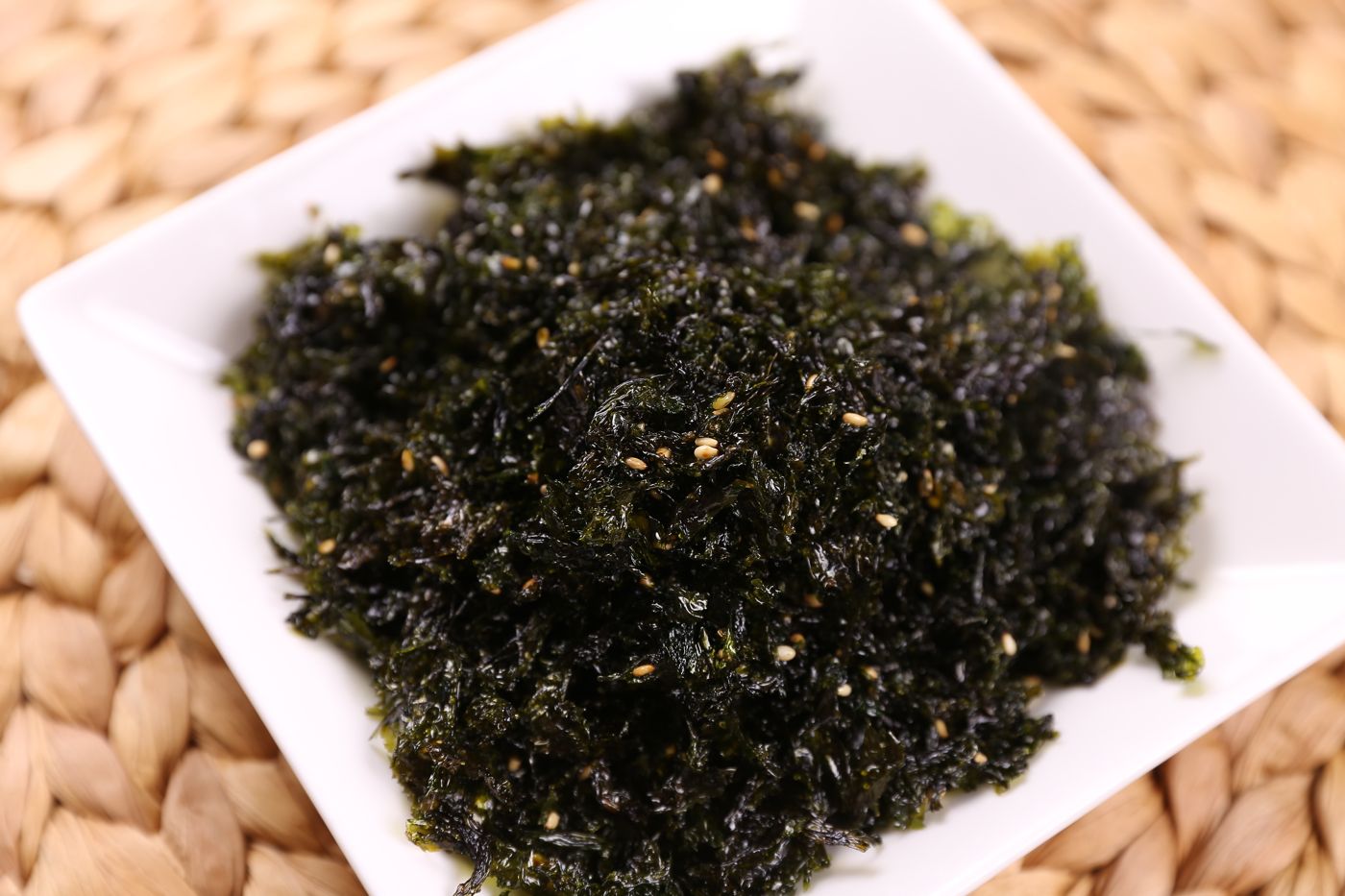
A fine, hair-like green seaweed raked by hand from the winter mudflats of Garorim Bay in Seosan and Taean, then pressed into thin sheets. It is sweeter and more delicate than gim.
Flavor
Sweet, faintly bitter and intensely green-smelling, like a softer, grassier gim; dried sheets are lacy and melt on the tongue.
Origin & History
The name gamtae ("sweet seaweed") belongs to two very different plants, and the distinction matters. On the west and southwest coasts, gamtae is the local name for gasi-parae, a thread-thin green alga of the sea-lettuce family (Ulva prolifera), finer than maesaengi and thinner than ordinary parae. In standard Korean biology, however, gamtae is Ecklonia cava, a stiff, bitter brown kelp that grows in underwater forests off Jeju and Ulleung. The Encyclopedia of Korean Folk Culture notes that the Jeju kelp is rarely eaten directly and is now protected as marine habitat. The gamtae of Seosan and Taean, and the one eaten as banchan, is the green alga.
Green gamtae grows only in winter, attached to the mud, twigs and farm structures of clean inner bays and estuaries with large tides, and melts away when spring warms the water. It is gathered from about December to March in Seosan and Taean, around Garorim Bay, and also on the coasts of Muan, Sinan, Jangheung, Wando, Tongyeong and Sacheon. Gatherers wade into the flats with a basin and pull it by hand, a job they compare to weeding a field, or scrape it with a wire rake; hand-picking is preferred because it keeps only the tender parts. The harvest is washed several times in seawater and then fresh water. The folk encyclopedia says it is sold fresh in fist-sized balls; in Seosan most is spread and dried into sheets like gim, a slow hand process that keeps prices high. A 2023 OhmyNews report counted it among Seosan's nine signature products and noted it has not been successfully farmed there.
Fresh gamtae is seasoned raw, cooked with oysters or radish, or made into gamtae-ji, a gamtae kimchi sold around the Lunar New Year in Muan market. Dried sheets are eaten much like gim, wrapped around rice. Newer uses include gamtae gimbap, rice balls, snacks and powders for processed foods.
Nutrition
| Calories | 136 kcal |
|---|---|
| Protein | 20 g |
| Fat | 0.7 g |
| Carbohydrates | 46.5 g |
| Fiber | Not reported |
| Sodium | 110 mg |
Notable forCalcium (646 mg) · Iron (37.2 mg) · Beta-carotene (2,070 µg) · Riboflavin (1.34 mg)
Values copied from the Korean Food Composition Table (Rural Development Administration / National Institute of Crop Science) for this exact food, per 100 g edible portion. Blank fields in the table are shown as not reported. The table has no entry under the name 감태; gasi-parae is the species the Encyclopedia of Korean Folk Culture identifies as west-coast gamtae. Values are for the dried product; one sheet weighs only a few grams. Actual values vary with ingredients, portion size and preparation.
Health Benefits
- Minerals in a light sheet: Dried gasi-parae in the Korean table is rich in calcium and iron and supplies beta-carotene, though a typical serving of a sheet or two is only a few grams.
- Iodine: MedlinePlus notes that seaweeds can be rich in iodine and that very high iodine intake can reduce thyroid function; people with thyroid conditions should ask their doctor how much seaweed is appropriate.
- Modest claims only: Local reports describe gamtae as good for aging, diabetes and fatty liver; such claims come from tradition and marketing, not clinical evidence, and research on this species is limited.
- Do not confuse with brown gamtae: Supplements and cosmetics sold as "gamtae" are usually made from Ecklonia cava, the Jeju brown kelp, not the green seaweed eaten as banchan.
Informational, not medical advice. Talk to a qualified professional about your own health and diet.
Dishes with Gamtae (thread-like green seaweed)
Dish guides featuring gamtae (thread-like green seaweed) are coming soon.
Sources
- 01감태채취 (Gathering gamtae) — Encyclopedia of Korean Folk Culture, National Folk Museum of Korea
- 02[맛있는 여행] 55- 태안 가로림만에 서식하는 바다의 약초 감태(甘苔) (Gamtae of Garorim Bay) — Joongdo Ilbo (2024)
- 03서산은 감태 수확 한창... '가로림만의 보물'이랍니다 (Seosan gamtae harvest) — OhmyNews (2023)
- 04Korean Food Composition Table — Sea lettuce, Green laver, Dried
- 05Iodine in diet — MedlinePlus Medical Encyclopedia (U.S. National Library of Medicine)