Ingredient
Danhobak (kabocha squash)
단호박
Romanization: danhobak
The "sweet pumpkin": a squat, dark-green winter squash with dense, fluffy, deep-orange flesh. Steamed whole, simmered into porridge or braised in soy sauce, it is one of Korea's most popular squashes.
Flavor
Very sweet and nutty, like a cross between sweet potato and chestnut, with dense, dry, fluffy flesh that turns velvety when mashed. The thin green skin is edible once cooked.
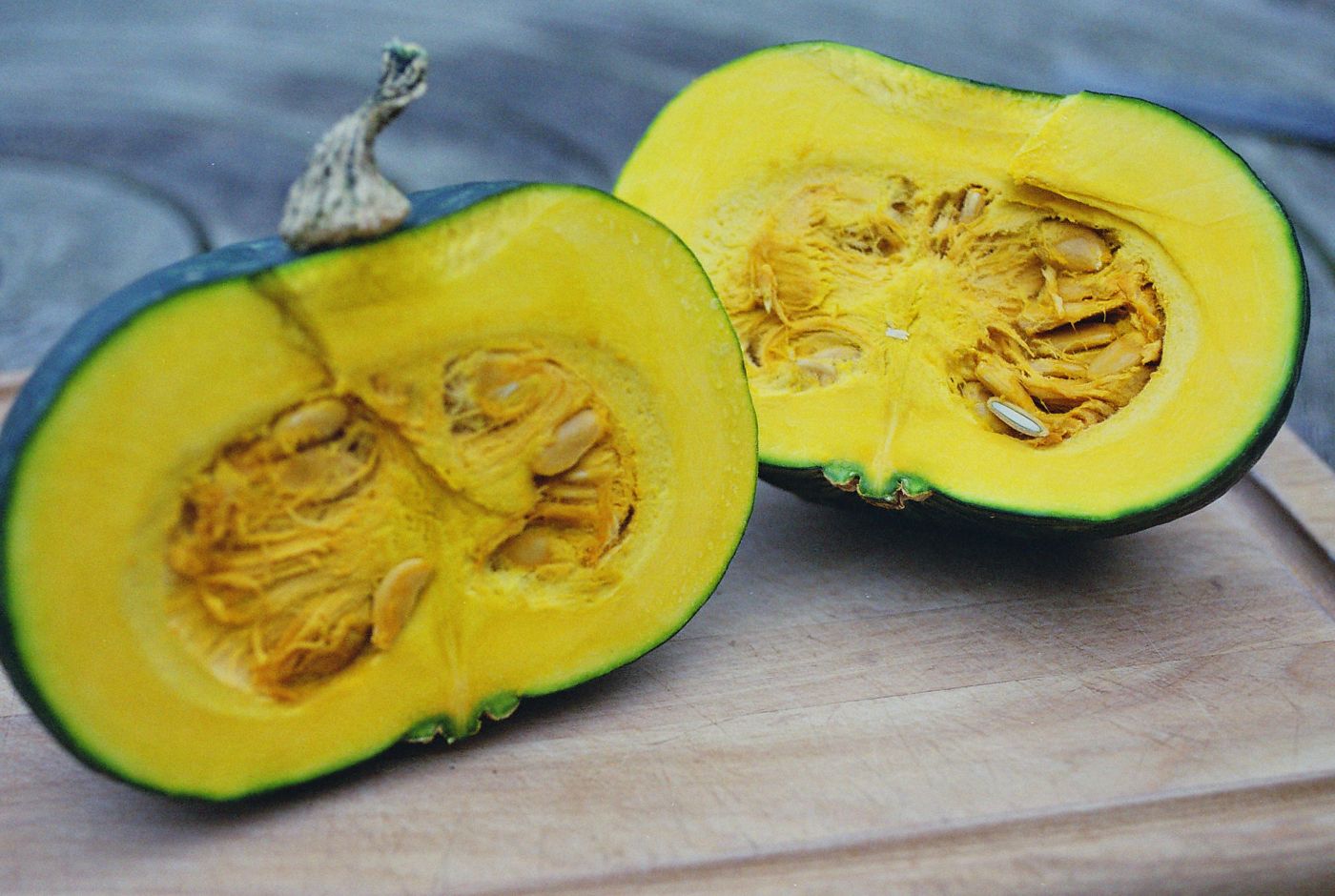 Photo: Namayasai LLP, CC BY-SA 3.0, via Wikimedia Commons
Origin & History
Korean cooks recognize three groups of hobak. The Oriental group (Cucurbita moschata) gives the young aehobak and the large neulgeun-hobak; the pepo group includes zucchini; and the Western group (Cucurbita maxima) is starchy and is eaten fully ripe, usually steamed. Danhobak belongs to this Western group. Like other squashes it is American in origin.
Its rise in Korea is recent and tied to Japan, where this squash is known as kabocha. According to the Jeju agricultural research and extension service, Korean danhobak farming began around 1985 on Jeju and in parts of Haenam, South Jeolla, as an export crop for Japan. Planting expanded rapidly from about 90 hectares in 1996 to over 900 hectares a decade later, and growing districts now include Yeoncheon and Hwaseong in Gyeonggi-do, Andong, Hapcheon, Sunchang, Jindo, Sinan and Aewol on Jeju. Most Korean danhobak are Ebisu-type varieties introduced from Japan. Once eaten mainly in hotels, it has become an everyday supermarket vegetable and a favorite of food processors.
Danhobak is harvested about 35 to 50 days after flowering and then cured for a week or so in a warm, shaded spot before storage, a step that heals the skin and helps convert starch to sugar. At home it is steamed and eaten plain, cooked into a smooth porridge like hobak-juk, braised in soy sauce, pan-fried as jeon, or steamed whole and stuffed.
Nutrition
| Calories | 57 kcal |
|---|---|
| Protein | 1.19 g |
| Fat | 0.65 g |
| Carbohydrates | 13.63 g |
| Fiber | 5 g |
| Sodium | 0 mg |
Notable forVitamin A (as beta-carotene) · Potassium · Vitamin E · Vitamin C
Korean Food Composition Table entry "Pumpkin, Kabocha squash, Raw" (호박, 단호박, 생것): also 3,670 µg beta-carotene (306 µg RAE vitamin A), 419 mg potassium, 3.05 mg vitamin E, 12.13 mg vitamin C and 4.74 g total sugars per 100 g. The Table reports sodium as 0. Actual values vary with ingredients, portion size and preparation.
Health Benefits
- Beta-carotene and fiber: Per the Korean Food Composition Table, danhobak is a source of beta-carotene (converted to vitamin A), potassium, vitamin E, vitamin C and fiber.
- Starchier than most vegetables: With about half again as many calories and as much carbohydrate as mature Korean pumpkin, it is closer to sweet potato than to leafy vegetables; count it as a starchy side when planning meals.
- Added sugar in dishes: Porridges, braises and desserts made with danhobak are often sweetened with sugar or syrup, making them richer than the plain steamed squash.
- Harmless color change: MedlinePlus notes that very high beta-carotene intake can tint the skin yellow-orange, which fades once intake falls.
Informational, not medical advice. Talk to a qualified professional about your own health and diet.
Dishes with Danhobak (kabocha squash)
Dish guides featuring danhobak (kabocha squash) are coming soon.