Ingredient
Bomdong (spring cabbage)
봄동
Romanization: bomdong
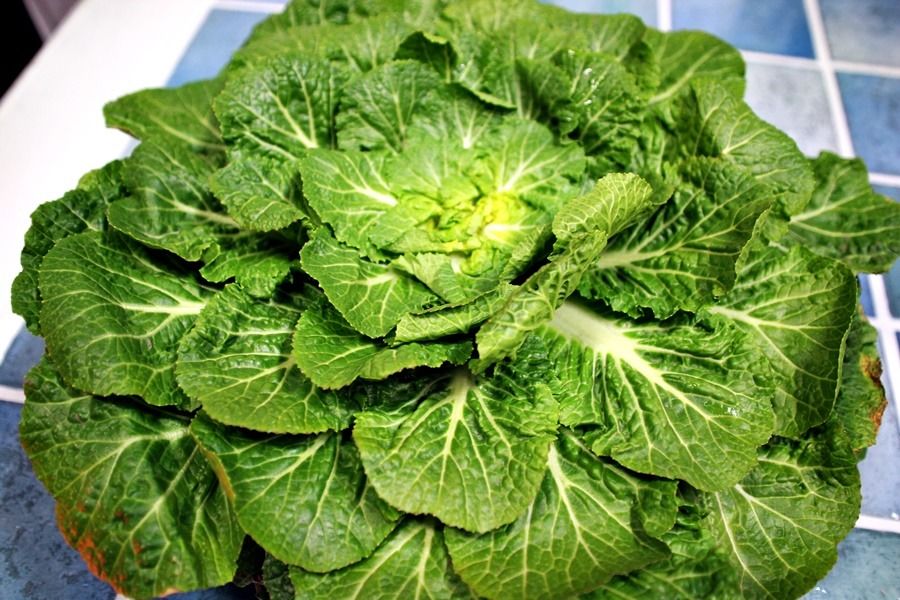
A loose, flat cabbage that spends the winter in open fields on Korea's southwest coast, its leaves spread wide against the ground. Sweet and crisp, it is dressed raw as bomdong geotjeori when spring is still weeks away.
Flavor
Sweeter and more delicate than headed napa cabbage, with a fresh, faintly nutty taste. The pale inner leaves are crisp and juicy and the outer leaves soft and tender.
Origin & History
Bomdong is a form of napa cabbage (baechu) that never forms a head. Sown in open fields in autumn, it grows through the winter with its leaves splayed outward in a flat rosette instead of folding into a tight head. In Korea it is also known as tteok-baechu. Folk explanations of the name vary; one popular account links it to the vegetable's flattened, ground-hugging shape. The Korean Food Composition Table lists it as a kind of napa cabbage (baechu, bomdong).
It is above all a crop of the mild southwestern coast of South Jeolla Province. Jindo, Haenam, Wando and Sinan produce almost all of Korea's bomdong, and Korean trade and farm press put the South Jeolla share at over 90 percent. Jindo is the best-known source. There, farmers sow in autumn and harvest through winter, and growers credit the cold sea winds for the cabbage's sweetness.
Harvest starts in late autumn, but bomdong is at its best from about January to March, when the leaves have weathered the cold. That timing makes it one of the first fresh greens of the new year on Korean tables, which explains the name: it is eaten as a herald of spring, not in spring itself.
The signature dish is bomdong geotjeori: the leaves are torn or cut and tossed straight in a dressing of gochugaru, fish sauce or soy sauce, garlic, a little vinegar or sugar and sesame, usually without salting first, so they stay crisp. Bomdong is also blanched for namul, simmered in doenjang-guk, used as a leaf wrap and mixed into bibimbap.
Nutrition
| Calories | 23 kcal |
|---|---|
| Protein | 1.81 g |
| Fat | 0.21 g |
| Carbohydrates | 4.78 g |
| Fiber | 2.2 g |
| Sodium | 30 mg |
Notable forVitamin K · Vitamin C · Calcium · Folate
Korean Food Composition Table entry "Kimchi cabbage, Spring green, Raw" (배추, 봄동, 생것): also 139.87 µg vitamin K, 30.18 mg vitamin C, 99 mg calcium, 82 µg folate and 1,015 µg beta-carotene (85 µg RAE vitamin A) per 100 g. Actual values vary with ingredients, portion size and preparation.
Health Benefits
- Winter green: Per the Korean Food Composition Table, bomdong provides vitamin K, vitamin C, folate, calcium and beta-carotene. That is noticeably more beta-carotene than pale headed cabbage, because it grows with its leaves open to the light.
- Eaten raw: Because bomdong is usually eaten raw in geotjeori, its vitamin C is not lost to cooking. Wash the leaves well, since soil collects at the base where they meet the root.
- Sodium in dressings: Raw bomdong is very low in sodium, but geotjeori dressings built on fish sauce, soy sauce and salt add a good deal. Season lightly if you are watching salt.
- Vitamin K and warfarin: Bomdong is a meaningful source of vitamin K. MedlinePlus advises people taking warfarin to keep their intake of vitamin K–rich greens consistent from week to week rather than eating large amounts at once. Talk with your doctor before changing your diet.
Informational, not medical advice. Talk to a qualified professional about your own health and diet.
Dishes with Bomdong (spring cabbage)
Dish guides featuring bomdong (spring cabbage) are coming soon.